
Introduction
Losar, the Tibetan New Year, is one of the most significant ritual and cultural observances in the Himalayan world. Derived from the Tibetan words lo meaning year and sar meaning new, Losar marks the first day of the first month of the Tibetan lunar calendar. Yet to define it simply as a New Year festival would be to reduce its civilizational depth. Losar represents the renewal of time itself, ritually, morally, cosmologically, and communally. It is a moment when the passage of time is not merely acknowledged but consciously purified, sanctified, and redirected toward ethical aspiration.
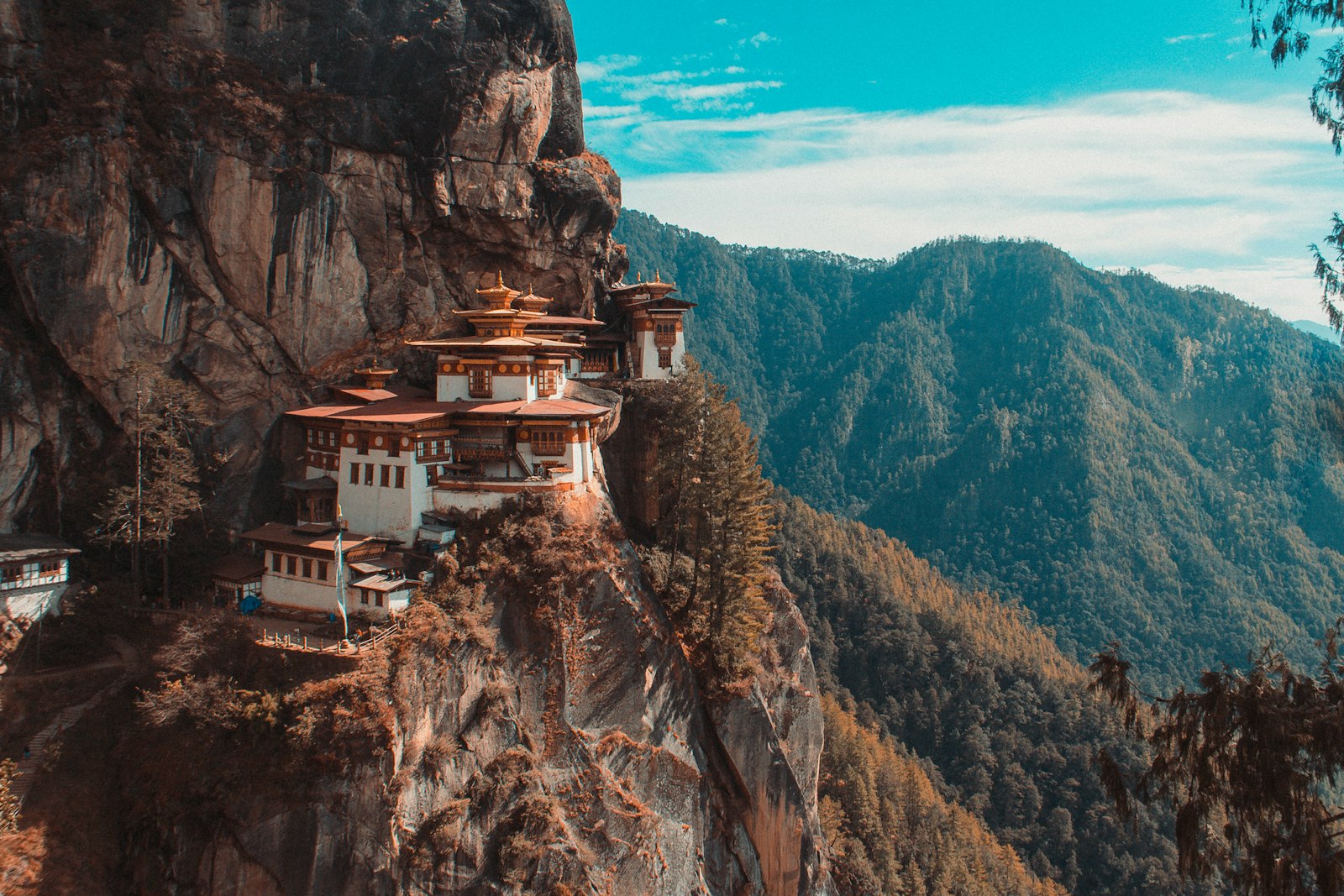
Celebrated across Tibet, Nepal, Bhutan, India (particularly in Ladakh, Sikkim, Arunachal Pradesh, and Himachal Pradesh), Mongolia, and Himalayan diaspora communities throughout Europe and North America, Losar functions as a unifying cultural axis for Tibetan Buddhist and Himalayan societies. It is a festival that integrates household ritual, monastic liturgy, public ceremony, artistic performance, and intergenerational transmission of knowledge. In villages, prayer flags are renewed on mountaintops. In monasteries, long horns resound through mountain valleys. In homes, altars are elaborately decorated with offerings symbolizing abundance and gratitude. Across geographical boundaries, Losar reaffirms shared heritage.
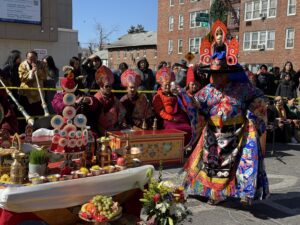
Historically, Losar embodies a layered synthesis of religious and political evolution. Its origins lie in the pre-Buddhist Bon tradition, where seasonal rites marked the winter solstice and agricultural cycles. These indigenous rituals emphasized purification and harmony between human communities and the natural world. With the emergence of sacred kingship in early Tibet and the establishment of the Yarlung dynasty, seasonal renewal became intertwined with political legitimacy. Later, during the seventh century, the formal introduction of Buddhism reshaped Losar into a festival infused with doctrinal meaning, transforming it from an agrarian observance into a spiritually conscious practice of karmic purification and ethical renewal.
Thus, Losar stands at the intersection of ecology, governance, and theology. It reflects how Himalayan communities historically understood time, not as linear progression but as a cyclical return requiring intentional renewal. The festival teaches that the transition from one year to the next is not automatic. It demands ritual cleansing, gratitude for past blessings, and aspiration for compassionate conduct in the year ahead.
In contemporary contexts, Losar also carries socio-political significance. For communities in exile, it serves as a vehicle of cultural preservation and identity affirmation. For Himalayan ethnic groups such as the Sherpa, Walung, Bhote, Tamang, Hyolmo, Dolpo, Mustang, Manang, Mugum and Gurung peoples, Losar reinforces ethnolinguistic distinctiveness while connecting them to broader Tibetan Buddhist civilization.
This article explores Losar as a historical institution, a ritual system, and a living cultural practice. By examining its origins, calendrical structure, zodiac symbolism, regional variations, and contemporary significance, we seek to understand how Losar continues to function as both a spiritual renewal and a civilizational anchor within Himalayan Communities.
Historical Origins: When and How Did Losar Begin?
When the long Himalayan winter loosened its grip and the first peach blossoms opened in the valleys of the Tibetan plateau, communities understood that the cycle of life had turned again. The blooming of peach flowers, particularly in lower river valleys such as Yarlung and parts of Tsang, was not merely botanical. It was cosmological. It signaled renewal. It marked the reawakening of earth after dormancy. In early Tibetan agrarian society, this seasonal transformation became the foundation of what would later be known as Losar, the Spring Festival and New Year.
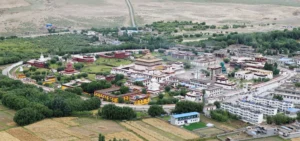
Long before the formal institutionalization of Buddhism in the seventh century, seasonal renewal ceremonies were embedded in the ritual ecology of the ancient Bon tradition. Early Tibetan sources and Bon ritual texts describe a worldview structured around cyclical balance between humans, landscape, and unseen forces. The harsh climate of the plateau — long winters, brief agricultural windows, environmental vulnerability — required not only physical endurance but spiritual negotiation with nature.
Within Bon cosmology:
-
Mountains were revered as living deities (Yul lha).
-
Territorial guardians protected valleys and settlements (gShi bdag).
-
Water sources were inhabited by serpent spirits known as Nagas (klu).
At the threshold of spring, communities gathered to perform purification rites. Juniper branches were burned to cleanse accumulated negativity from the passing year. Offerings of barley, butter, and chang (fermented grain drink) were made to local deities. Invocation prayers were recited to ensure fertility of land, protection of livestock, and harmony between human and spiritual realms.
These ceremonies marked the symbolic death of winter and the rebirth of seasonal life. Although the term “Losar” was not yet standardized, the essential elements were present: purification, thanksgiving, protection, and the renewal of time itself. In this sense, Losar began as a Spring Festival rooted in agricultural and cosmological awareness.
By the early centuries of the Common Era, these rites gradually acquired political dimension. As Tibetan tribal polities consolidated into centralized authority structures, seasonal renewal became intertwined with governance. Tibetan historical traditions, preserved in chronicles such as the Old Tibetan Annals and later historiographies, indicate that New Year observances were incorporated into royal ceremonial life.
During the era associated with King Pude Gungyal (traditionally placed in the fourth century), references suggest that New Year rites were formalized within state ritual frameworks. The renewal of the agricultural year became synchronized with the reaffirmation of political authority. Time was no longer only seasonal — it became political. The turning of the year symbolized stability, legitimacy, and continuity of rule.
The sacred character of Tibetan kingship is traditionally traced to Nyatri Tsenpo, whose reign is dated in Tibetan historiography to 127 BCE. Chronicles recount that Nyatri Tsenpo descended from the heavens into the Yarlung Valley, establishing a divine lineage. While modern scholarship debates the literal historicity of this narrative, its symbolic meaning is central: Tibetan kingship was understood as cosmologically sanctioned. The ruler mediated between heaven and earth.
Seasonal renewal ceremonies, including early Losar observances, became mechanisms through which the king ritually reaffirmed harmony between celestial and terrestrial realms. Renewing the year meant renewing sovereignty and restoring moral order.
A profound transformation occurred in the seventh century during the reign of Songtsen Gampo. His reign marked the formal introduction and institutionalization of Buddhism in Tibet through diplomatic and religious exchanges with India and Nepal. Rather than erasing Bon traditions, Buddhist scholars and ritual specialists integrated existing spring purification ceremonies into a broader doctrinal framework.
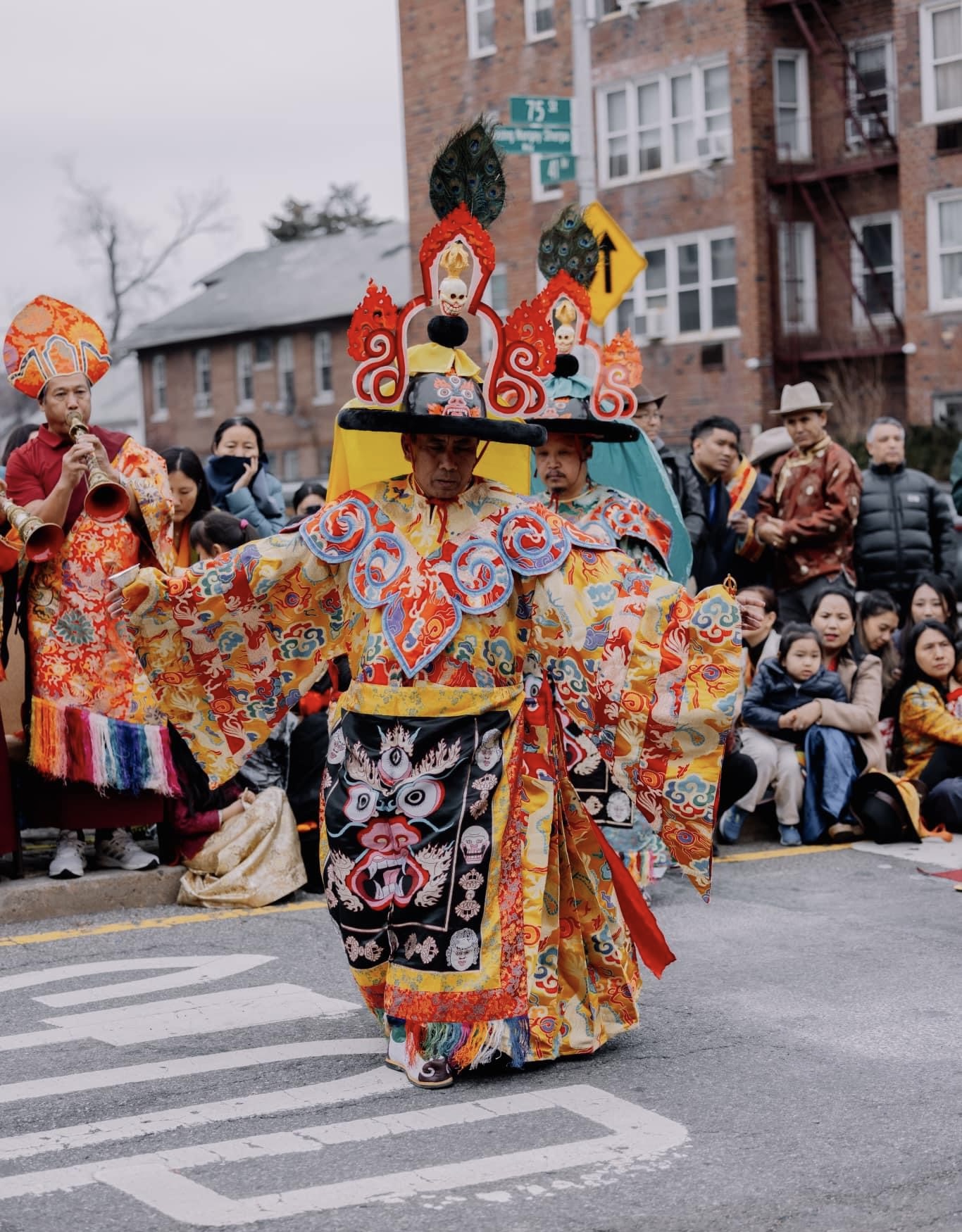
Indigenous rites of seasonal cleansing were reinterpreted through Buddhist ethical and soteriological principles. The New Year became an occasion not only to appease territorial spirits but also to purify karma, cultivate compassion, and renew commitment to spiritual practice. Over time, monastic rituals such as cham dances, public teachings, and communal prayers were incorporated into Losar celebrations.
By the medieval period, Losar had evolved into a fully structured New Year festival aligned with the Tibetan lunar calendar. Its ritual complexity reflected centuries of integration rather than replacement. It retained Bon cosmology, incorporated royal ceremony, and absorbed Buddhist philosophical meaning.
Thus, what began when peach blossoms opened against melting snow matured into a civilizational institution. Losar emerged as both Spring Festival and sacred renewal — of land, authority, and conscience.
In its historical trajectory, Losar reveals how Tibetan civilization wove together indigenous spirituality, sacred kingship, and Buddhist doctrine into a single calendrical observance. The blooming of spring became not only a sign of seasonal survival, but a reaffirmation of cosmic and moral harmony.
The Tibetan Calendar: Cycles, Cosmology, and the Meaning of Years
The Tibetan calendar is a sophisticated lunisolar system that integrates astronomical calculation, cosmological symbolism, and ritual timekeeping. Its foundations draw heavily from Indian astronomical science, particularly the Kalachakra (Wheel of Time) tradition, while also incorporating elements transmitted through Central Asian and Chinese calendrical systems. Over centuries, Tibetan scholars adapted these influences into a uniquely Tibetan framework that harmonizes lunar cycles, solar adjustments, and astrological symbolism.
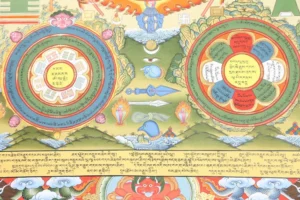
Unlike the modern Gregorian calendar, which operates through a linear progression of numbered years, the Tibetan calendar functions through cyclical time. Time is not merely counted forward. It rotates through patterned sequences that repeat rhythmically. This cyclical conception reflects a broader Himalayan worldview in which the cosmos operates through recurring patterns rather than irreversible linear movement. Renewal, therefore, is not accidental. It is structurally embedded within time itself.
The 12 Year Animal Cycle
At the core of the Tibetan calendrical system is the twelve year animal cycle, in which each year is associated with a specific animal. These animals follow a fixed sequence:
-
Mouse (Rat)
-
Ox
-
Tiger
-
Rabbit
-
Dragon
-
Snake
-
Horse
-
Sheep
-
Monkey
-
Bird (Rooster)
-
Dog
-
Pig
After the twelfth year, the sequence begins again with the Mouse, forming a perpetual twelve year rhythm. This cycle is shared across much of Inner Asia, yet within Tibetan tradition it has developed distinct symbolic interpretations.
Each animal is associated not merely with folklore but with cosmological qualities that influence cultural perceptions of the year’s character. These symbolic associations shape expectations, rituals, and even individual astrology.
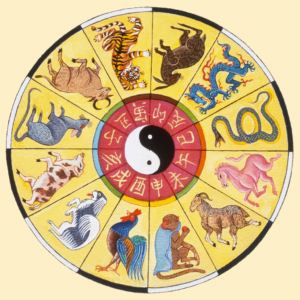
• Mouse (Rat): Represents intelligence, adaptability, and resourcefulness. It signifies beginnings, strategic thinking, and the ability to survive through subtlety.
• Ox: Symbolizes diligence, endurance, and grounded stability. Ox years are often perceived as periods of steady labor and patient progress.
• Tiger: Embodies courage, dynamic power, and unpredictability. It is associated with bold action and transformative intensity.
• Rabbit: Represents gentleness, diplomacy, creativity, and sensitivity. Rabbit years are often interpreted as favoring negotiation and artistic refinement.
• Dragon: Symbolizes authority, vitality, charisma, and spiritual potency. It carries connotations of leadership and expansive energy.
• Snake: Associated with wisdom, introspection, strategy, and transformation. Snake years are linked to reflection, subtle change, and intellectual depth.
• Horse: Represents freedom, momentum, vitality, and movement. It is connected to expansion, travel, and dynamic change.
• Sheep (Goat): Symbolizes compassion, harmony, aesthetic sensitivity, and communal balance. Sheep years are often seen as nurturing and cooperative.
• Monkey: Associated with cleverness, curiosity, humor, and ingenuity. Monkey years emphasize innovation and mental agility.
• Bird (Rooster): Represents precision, discipline, alertness, and communication. It suggests attention to detail and structured effort.
• Dog: Symbolizes loyalty, justice, protection, and moral vigilance. Dog years often emphasize ethical responsibility and communal defense.
• Pig: Represents generosity, sincerity, abundance, and prosperity. Pig years are associated with material well being and honest intentions.
These symbolic attributes do not function as deterministic predictions but as archetypal patterns guiding interpretation. Communities often reflect upon the nature of the upcoming animal year when making plans or assessing broader social trends. In this sense, the animal cycle functions pedagogically, encouraging reflection on character, virtue, and collective behavior.
The Five Elements and the Sixty Year Cycle
The twelve animals operate in combination with five fundamental elements:
• Wood
• Fire
• Earth
• Iron (Metal)
• Water
Each element manifests in both male and female forms, creating a ten year elemental sequence. When combined with the twelve animals, they generate a complete sixty year cycle known as a Rabjung. Every year is therefore defined by both its animal and its element (for example, Wood Dragon, Fire Tiger, Earth Horse, Iron Monkey, or Water Pig).
After sixty years, the full cycle repeats. This sixty year rhythm is deeply significant in Tibetan culture. Completing one full Rabjung is considered an important life milestone, marking a complete cosmological return.
Cyclical Time and Cultural Meaning
The Tibetan calendar’s cyclical structure reflects a broader philosophical understanding rooted in Buddhist and indigenous cosmology. Time is neither random nor strictly linear. Instead, it unfolds through patterned recurrence, suggesting that renewal, decline, and transformation are woven into the structure of existence.
Losar, as the inauguration of a new animal element year, becomes a ritual moment of recalibration within this cosmic pattern. The symbolic character of the animal and element of the year informs cultural expectations and spiritual reflection. Communities interpret the year’s qualities as invitations to cultivate corresponding virtues, whether wisdom, diligence, compassion, courage, or patience.
Thus, the Tibetan calendar is not simply a tool for marking dates. It is a cosmological system that integrates astronomy, symbolism, ethics, and communal memory. Through its cyclical design, it reinforces the idea that each year offers a renewed opportunity to align human conduct with the patterned harmony of the cosmos.
Ritual Structure of Losar
The observance of Losar unfolds through a carefully structured ritual sequence that integrates purification, preparation, spiritual devotion, and communal celebration. Far from being a single-day event, Losar represents a gradual and conscious transition, moving from the accumulated burdens of the past year into a renewed moral and spiritual beginning.
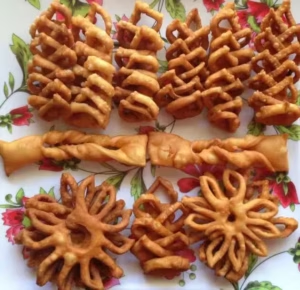
Preparation often begins one to two weeks in advance. Households enter a rhythm of anticipation. Women and elders begin brewing Tshyang (home-made rice or barley alcohol), allowing it to ferment in time for ceremonial offerings and festive sharing. Large batches of Khapse (deep-fried ceremonial cookies) are prepared in intricate shapes — knots, braids, crescents, and flowers, symbolizing prosperity and continuity. Barley or wheat seeds are planted in shallow trays to grow tender green shoots known as Lo Phud, representing agricultural fertility and the renewal of life.
Grains are cleaned and roasted for Chemar (a mixture of roasted barley and wheat flour). Butter is churned for lamps and decorative sculptures. Homes are aired, textiles washed, and ritual objects polished. Children are often given new clothes. In many communities, families consult astrologers to determine auspicious days for particular preparations.
Thus, Losar begins not with a single ritual, but with a slow cultural crescendo. Preparation itself becomes an act of purification.
The ritual sequence reflects centuries of integration between Bon purification rites, royal ceremony, and Buddhist liturgical practice.
Gutor: The Ritual Purification (29th to 30th Days of the Final Month)
The days immediately preceding Losar are known collectively as Gutor, literally meaning offering of the 29th. These preparatory days serve as a liminal period during which accumulated negativity is identified, symbolically externalized, and expelled.
The 29th Day: Gu thuk and the Expulsion of Negativity
On the 29th day of the twelfth lunar month, families gather in the evening to share Gu thuk (often written as Guthuk), a special hand-rolled noodle soup( stew) prepared with nine ingredients. The number nine is symbolically significant, often associated with completeness or totality. The soup includes various vegetables, handmade noodles, and spices, representing abundance and communal sharing.

Inside certain handmade noodles, small hidden items are placed, pieces of charcoal, wool, chili, salt, or paper inscribed with symbols. When family members discover these objects while eating, playful interpretations are offered. Charcoal may symbolize a dark heart, wool gentleness, chili sharp speech, salt dullness, or a bean stubbornness. Although humorous in tone, this ritual functions as collective introspection. It allows individuals to reflect upon personal traits accumulated during the year, acknowledging imperfections with laughter rather than judgment.
Following the meal, a dough effigy known as Glud is fashioned. The effigy symbolically absorbs the misfortunes, illnesses, obstacles, and negative influences that have affected the household throughout the year. Family members may symbolically touch the effigy or gesture toward it, transferring unwanted energies into it. The Glud is then carried outside and ritually discarded, sometimes at a crossroads, representing the expulsion of accumulated negativity from the domestic sphere.
In monastic settings, elaborate purification ceremonies are conducted, including ritual dances (Cham) that dramatize the triumph of wisdom over harmful forces. The Gutor period thus represents a symbolic cleansing of both household and cosmos.
The 30th Day: Nam gang and Domestic Renewal
The 30th day of the final lunar month, known as Nam gang, marks the final preparation before the New Year. On this day, homes are thoroughly cleaned, walls repainted or repaired, and altars rearranged. Windows and doorways may be decorated with auspicious symbols drawn in flour, representing the sun, moon, or stars.
Cleaning during Nam gang is not merely hygienic but symbolic. Dust and disorder represent the residue of past misfortune. Removing them enacts moral purification. In many traditions, men bathe on the 29th and women on the 30th, signifying communal readiness to enter the New Year in a state of ritual freshness.
Household altars (mChod gShom) are prepared with offerings such as Derkha (arranged fried pastries), Yon chab (seven water bowls), Lo puth (wheat sprouts), Chang phuth (barley beer), and Chemar (roasted barley and wheat grains). Butter lamps are arranged, incense is readied, and ceremonial scarves (khata) are placed for offering.
Nam gang thus marks the threshold between old and new time. The household becomes ritually transformed into a purified sacred space.
The First Three Days of Losar
The New Year proper unfolds across the first three days, each carrying distinct spiritual and communal significance.
Day One: Lama Losar
The first day of Losar is devoted primarily to spiritual observance and family cohesion. Known as Lama Losar, it emphasizes reverence for religious teachers and devotion to the Three Jewels (Buddha, Dharma, Sangha). Families rise early to perform household prayers and make offerings at their altars. Fresh prayer flags may be raised, symbolizing renewed aspiration.
Visits to monasteries are central. Individuals offer khatas to lamas, receive blessings, and participate in long life prayers (Tsedor). Monastic rituals invoke auspiciousness, protection, and spiritual clarity for the coming year. Traditionally, the first day is spent primarily within the family circle, reinforcing intimate bonds.
The tone of Lama Losar is contemplative and reverential. It centers on spiritual alignment before social expansion.
Day Two: Gyalpo Losar
The second day, known as Gyalpo Losar (King’s New Year), historically commemorated the authority of Tibetan kingship and state unity. In ancient times, officials and representatives would present themselves at the royal court, offering greetings and affirming loyalty.
Today, this day is marked by public celebrations, cultural performances, and communal gatherings. Traditional dances, music, and festive attire transform public spaces into arenas of shared identity. Community leaders exchange greetings, and families visit friends and relatives beyond their immediate households.
Gyalpo Losar thus expands the focus from spiritual interiority to civic and communal solidarity.
Day Three: Chokyong Losar
The third day, Chokyong Losar, is dedicated to guardian deities and protective forces. Prayer flags are hoisted on rooftops and hillsides, releasing inscribed mantras into the wind. Offerings are made to territorial deities and local protectors to ensure safety and prosperity.
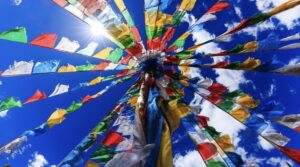
This day reflects the continued influence of ancient Bon cosmology within Buddhist practice. The honoring of guardian spirits acknowledges the enduring relationship between community and landscape. Rituals emphasize harmony with both visible and invisible dimensions of existence.
Ritual as Transition and Renewal
The structured sequence of Losar, from Gutor purification through the first three days, reveals a carefully layered ritual architecture. The process begins with introspection and expulsion of negativity, proceeds through spiritual alignment, and culminates in communal and cosmological reaffirmation.
Losar does not merely celebrate a change in date. It enacts a deliberate transition from disorder to harmony, from accumulation to release, and from fragmentation to renewed collective coherence. Through this ritual structure, time itself is cleansed, blessed, and reoriented toward ethical and spiritual aspiration.
Domestic Altars and Symbolic Offerings During Losar
At the heart of Losar observance lies the household altar, known in Tibetan as mChod gShom. More than a decorative arrangement, the altar functions as the sacred center of domestic ritual life. During Losar, it becomes a microcosm of the cosmos itself, an ordered sacred space through which gratitude, aspiration, purification, and continuity are expressed. The preparation of the altar is not merely aesthetic. It is theological, pedagogical, and intergenerational.
In Tibetan and Himalayan households, the altar typically occupies the most honored space within the home. Images or statues of the Buddha, bodhisattvas, lineage masters, and protector deities are placed upon it. During Losar, this space is thoroughly cleaned and renewed, symbolizing the purification of mind and environment. Offerings are arranged with precision and intention, reflecting both ritual discipline and symbolic depth.
Derkha: The Auspicious Offering of Abundance
One of the most visually striking elements of the Losar altar is the Derkha, an elaborate arrangement of khapse, deep fried pastries prepared specifically for the New Year. The term Derkha combines der meaning plate and kha meaning mouth, indicating a grand offering plate presented before the deities.
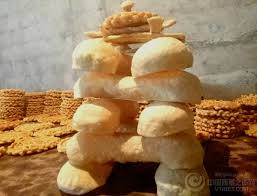
The Derkha is not randomly assembled. It is carefully structured to reflect auspicious geometry and symbolic motifs, often evoking the Eight Auspicious Symbols (Tashi Tagye). At its center frequently stands the tall, sculptural pastry known as Bongbu achok (donkey’s ear), whose distinctive elongated shape forms the vertical axis of the arrangement. Around it are placed various other forms of khapse, each shaped differently, creating a harmonious composition.
Beyond aesthetics, the Derkha symbolizes abundance, generosity, and gratitude. It represents the household’s offering of the fruits of labor to the sacred realm. By presenting food first to the deities, the family acknowledges that prosperity arises through the interplay of human effort and spiritual blessing.
Yon chab: The Seven Traditional Offerings
Arranged neatly before sacred images are seven bowls of water known as Yon chab. These bowls represent the classical seven offerings made to enlightened beings in Tibetan Buddhist practice:
-
Drinking water (Chod yon)
-
Water for washing the feet (Zhab sil)
-
Flowers (Metok)
-
Incense (Dugpo)
-
Scented water (Dri chab)
-
Food (Zhal se)
-
Music (symbolically represented)
Each bowl is filled with clear water and aligned symmetrically, symbolizing purity and clarity of intention. The offering sequence mirrors the traditional reception of an honored guest in ancient Indian culture, reflecting hospitality toward the enlightened ones.
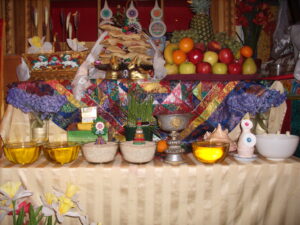
During Losar, these offerings take on heightened meaning. They represent the aspiration to begin the year with generosity, humility, and reverence. The simplicity of water, clear and unadorned, reminds practitioners that sincere intention surpasses material value.
Lo puth: The Green Shoots of Renewal
Another important element on the altar is Lo puth, young green shoots of wheat or barley grown in small containers in the days leading up to Losar. Their fresh, vibrant color symbolizes agricultural fertility, regeneration, and hope for prosperity in the coming year.

In agrarian societies of the Himalayas, the success of crops historically determined communal survival. The presence of Lo puth on the altar acknowledges the interdependence between human labor and natural cycles. It also symbolizes inner growth, the cultivation of virtue and spiritual discipline, mirroring the sprouting of seeds.
Chang phuth: The First Offering of the New Year
Chang phuth refers to the first bowl of barley beer (chang) brewed for the New Year. Before it is consumed by family or guests, a portion is offered at the altar in thanksgiving. This act reflects the principle that all nourishment and celebration should begin with gratitude.

The offering of chang also retains echoes of ancient Bon libation practices, demonstrating continuity between indigenous ritual and Buddhist reinterpretation. In offering the first portion to the sacred realm, the household ritually aligns pleasure with reverence.
Chemar: The Ritual Greeting of Prosperity
Among the most interactive altar elements is Chemar, a wooden container divided into two sections, one holding roasted barley flour (tsampa) and the other wheat grains. Both are shaped into small conical mounds, often adorned with decorative wooden ornaments.
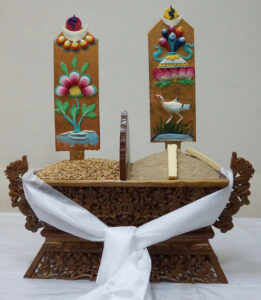
Chemar plays a central role in Losar greetings. When visitors arrive, they are offered a pinch of roasted barley flour, which they toss lightly upward in a gesture of auspiciousness before partaking. The exchange is accompanied by the greeting Losar Tashi Delek, meaning Auspicious blessings for the New Year.
Chemar thus bridges sacred offering and social ritual. It transforms hospitality into a symbolic affirmation of abundance, goodwill, and shared fortune.
The Altar as Pedagogy and Cultural Transmission
The domestic altar during Losar functions as more than a ritual display. It is a site of education. Children learn the names and meanings of offerings through participation in preparation. They observe how gratitude is expressed before consumption, how abundance is shared before enjoyed, and how symbolic forms convey ethical values.
Through repetition across generations, the altar transmits cosmological literacy. It teaches that prosperity requires gratitude, that renewal requires purification, and that human effort operates within a broader web of visible and invisible relationships.
Reciprocity and Cosmological Balance
Collectively, the offerings of Derkha, Yon chab, Lo puth, Chang phuth, and Chemar embody the reciprocal relationship between human endeavor and divine blessing. The household acknowledges dependence upon environmental forces, protective deities, ancestors, and enlightened beings. In return, it offers respect, gratitude, and aspiration.
Thus, the Losar altar becomes a microcosm of Himalayan cosmology. It unites ecology, theology, economy, and ethics within a single domestic ritual space. In renewing the altar each year, families symbolically renew their relationship with the cosmos, entering the New Year not merely with celebration, but with conscious reverence and hope.
Regional Variations and Cultural Adaptation of Losar Across the Himalayan World.
Although Losar originates from a shared Tibetan calendrical and religious framework, its celebration across the Himalayan region reveals significant regional variation shaped by migration histories, ecological conditions, political structures, and indigenous traditions. Rather than existing as a rigid or uniform festival, Losar has evolved through cultural adaptation. Its capacity to integrate local customs while maintaining cosmological continuity demonstrates its resilience as a civilizational institution.
Nepal: A Multi Ethnic Landscape of Losar Traditions
Nepal represents one of the most diverse and dynamic settings for Losar observance. Within its borders, Losar is celebrated by multiple Himalayan ethnic groups, each interpreting the New Year through its own historical and cultural lens.
Among the Sherpa community of Solukhumbu and other Himalayan districts, Gyalpo Losar is observed according to the Tibetan lunar calendar. Monasteries such as Tengboche, Pangboche, and Thame serve as ritual centers where monks conduct extensive prayers, Cham dances, and protector deity ceremonies. Domestic altars are carefully prepared with Chemar (roasted barley and wheat), Lo puth (wheat sprouts), Derkha (arranged khapse), and offerings of butter lamps. Prayer flags are renewed on mountain ridges, symbolizing both spiritual aspiration and alignment with the natural landscape. For Sherpas, Losar reinforces continuity with Tibetan Buddhist heritage while simultaneously affirming their place within Nepal’s pluralistic society.
The Tamang community, concentrated in mid-hill regions and the Kathmandu Valley, celebrates Sonam Losar. In urban centers such as Kathmandu, large public festivals feature Tamang Damphu drum performances, traditional dances, cultural parades, and community feasts. Sonam Losar has become not only a religious observance but also an expression of indigenous ethnic identity within Nepal’s broader political framework. Public recognition of Sonam Losar reflects processes of ethnic revitalization and cultural affirmation.
Similarly, the Gurung (Tamu) community celebrates Tamu Losar, usually in late December. Cities such as Pokhara host extensive Tamu Losar programs, featuring traditional Gurung attire, ancestral rituals, and communal gatherings. Tamu Losar emphasizes lineage continuity, ancestral remembrance, and clan solidarity. It reflects the Gurung people’s distinct calendrical tradition while maintaining cultural dialogue with Tibetan Buddhist influence.
Additionally, Tibetan refugee communities in Nepal, particularly around Boudhanath in Kathmandu and settlements in Pokhara, celebrate Gyalpo Losar with strong monastic and diaspora dimensions. Monasteries surrounding the Boudhanath Stupa become focal points of liturgical ceremonies, cultural performances, and collective gatherings. In this context, Losar functions as both spiritual renewal and preservation of Tibetan identity in exile.
Nepal therefore, illustrates how a single calendrical concept, Losar, can manifest in multiple ethnocultural forms within one national context. It demonstrates the coexistence of indigenous calendars, Tibetan Buddhist traditions, and modern political recognition.
Ladakh: Monastic Ritual and Dramatic Performance
In Ladakh, Losar is deeply embedded in monastic ritual culture. Major monasteries such as Hemis, Thiksey, and Spituk host elaborate Cham dances, in which monks wearing intricate masks perform ritual dramas depicting the subjugation of ignorance and harmful forces. These performances are not merely artistic but sacramental. They are understood to purify the environment and renew spiritual protection.
Torch processions, often referred to as Metho rituals, symbolically burn away negativity. In Ladakh’s stark high altitude environment, Losar transforms winter landscapes into sacred ceremonial spaces. The festival serves as a bridge between monastic authority and village life.
Sikkim: Syncretic Expression of Tibetan and Indigenous Traditions
In Sikkim, Losar, sometimes known locally as Namsoong, blends Tibetan Buddhist practices with indigenous Lepcha and Bhutia traditions. Monastic ceremonies coexist with state sponsored cultural programs and communal feasts. The celebration reflects the state’s multi ethnic composition and its historical integration into the Indian political framework.
Losar in Sikkim functions both as religious observance and as public cultural display, highlighting the interplay between heritage preservation and modern governance.
Arunachal Pradesh: Village Ritual and Cross Border Cultural Memory
Among the Monpa communities of Arunachal Pradesh, Losar incorporates Tibetan Buddhist liturgy while retaining indigenous ritual patterns. Village gatherings emphasize communal prayer, song, and dance. The celebration reflects centuries of cultural exchange across Himalayan frontiers, where political borders have shifted but ritual memory has endured.
Himachal Pradesh: Household and Monastic Integration
In Lahaul and Spiti regions of Himachal Pradesh, Losar is observed with strong integration between domestic ritual and monastic practice. Households perform Gutor purification rites, prepare altars, and renew prayer flags, while monasteries conduct Cham dances and public ceremonies. The festival strengthens ties between family, monastery, and landscape.
Core Themes Across Regional Variations
Despite regional diversity, including Nepal’s plural forms, certain core principles remain constant across all manifestations of Losar:
• Ritual purification of accumulated negativity
• Renewal of ethical intention
• Gratitude for past blessings
• Strengthening of communal solidarity
• Alignment with cosmic and ecological cycles
Losar consistently marks a structured transition from disorder to harmony. Its regional adaptations demonstrate flexibility without abandoning foundational cosmological meaning.
Losar in Diaspora and Contemporary Context
The displacement of Tibetan communities in the mid twentieth century introduced new sociopolitical dimensions to Losar. In exile settlements across India and Nepal, the festival became a primary mechanism for preserving language, ritual knowledge, and collective identity. Schools, monasteries, and cultural associations organize Losar events that combine religious ceremonies with educational programs and artistic performances.
In diaspora communities in Europe and North America, Losar functions as a transnational cultural anchor. Celebrations reinforce intergenerational continuity, allowing younger generations born outside the Himalayan region to engage with ancestral heritage.
Within contemporary Tibet, however, large public expressions of Tibetan cultural identity are politically sensitive. Restrictions on gatherings may limit overt celebration. Under such conditions, Losar acquires additional symbolic meaning: ritual continuity becomes an affirmation of cultural resilience.
Philosophical and Educational Significance
From an educational perspective, Losar offers a rich case study in ritual adaptation and cultural continuity. It demonstrates how religious traditions evolve through integration rather than erasure. Bon cosmology, sacred kingship, Buddhist philosophy, and regional cultural forms have coalesced into a multi layered New Year observance.
Philosophically, Losar embodies cyclical time and conscious renewal. The repetition of the year is not passive recurrence. It requires ethical recalibration. Through purification rites, altar offerings, communal dances, and prayer flag renewal, communities intentionally align themselves with moral aspiration.
Across Nepal, Ladakh, Sikkim, Arunachal Pradesh, Himachal Pradesh, Tibet, and diaspora contexts, Losar continues to function as both ritual and philosophy, renewing not only the calendar, but the moral and cultural fabric of Himalayan societies.