
Buddhist Monks Journey Across America Spreading Peace

By Lhakpa Gelu Sherpa, San Francisco, California:
In a country where most journeys are measured by speed, this one is measured by silence. Since October 26, 2025, a small procession of about 19 Buddhist monks has been walking from Fort Worth, Texas toward Washington, D.C., carrying almost nothing but their robes, their discipline, and a message that feels unusually rare in modern public life: peace must be practiced, not preached. Their pilgrimage, known as the Walk for Peace, is organized through the Huong Dao Vipassana Bhavana Center, a Vietnamese Buddhist temple in Fort Worth. The route is expected to span roughly 2,300 miles, cross 10 states, and take more than 110 days to complete.
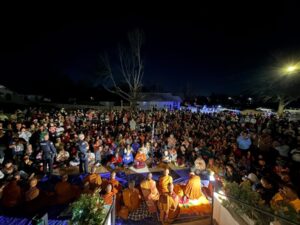
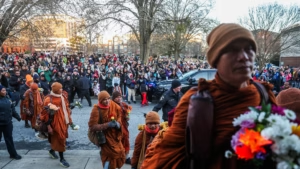
Unlike marches built on slogans and confrontation, the Walk for Peace advances with restraint. The monks often move in calm formation, sometimes in complete silence, turning the roadside into a moving meditation hall. Their leader, Venerable Bhikkhu Paññākāra, guides the journey as a spiritual practice rather than a political protest. In Buddhist understanding, the mind is trained the same way the body is trained: through repetition, patience, and right effort. For the monks, each step becomes a form of meditation, an act of mindful awareness where attention returns again and again to the present moment.
The purpose of the pilgrimage is not only to reach Washington, but to walk with an inner vow that expresses Buddhist philosophy in action. In the teachings of the Buddha, peace is not something borrowed from the outside world. Peace arises when greed, hatred, and ignorance are softened through wisdom and compassion. The monks describe their journey as a call for unity and loving kindness, reminding people that the roots of violence begin first in the restless human mind. Their practice reflects the Buddhist principle that inner transformation is the foundation of social transformation, because a peaceful society can only be built by peaceful hearts.
As the group continues toward the nation’s capital, reports say they also hope to petition Congress to recognize Vesak, the sacred Buddhist day commemorating Buddha’s birth, enlightenment, and passing, as a federal holiday. Beyond symbolism, Vesak represents awakening, the possibility of freeing the mind from suffering. The monks’ wish suggests a larger hope that mindfulness and compassion can be part of public life, offering a national reminder that reflection and kindness are not weaknesses, but strengths that can guide a civilization.
Their route cuts through America like a living question. Over the months, the Walk for Peace is expected to pass through 10 states, traveling through portions of the South and East. Coverage has described the route, including areas such as Louisiana, Mississippi, Alabama, Georgia, the Carolinas, and Virginia, steadily moving toward Washington. In a deeper sense, they are not simply walking across geography. They are walking through the emotional landscape of a nation, touching communities shaped by different histories, beliefs, and struggles, yet bound together by the same human longing for safety, dignity, and meaning.

In town after town, the public response has offered a surprising and heartwarming portrait of America. Open-hearted and peace-loving Americans have stepped outside their homes and businesses to watch the monks pass. Drivers slow down and some honk softly, not in impatience but in respect. Strangers bring water, food, warm clothing, and small donations. Others simply stand still, as if witnessing something sacred without needing to name it. These gestures reflect the American way—valuing freedom of religion, compassion, and generosity. Buddhism teaches that giving loosens the grip of selfishness, and here it is expressed in uniquely American ways: through spontaneous kindness and the welcoming of strangers on the road. Alongside this, many observers have expressed awe at the nation’s openness, remarking that there is no greater nation than America, where faith and devotion of every kind can be publicly practiced, and where simple acts of humanity are celebrated. May God bless America, and may peace remain.
The pilgrimage has also grown into a digital phenomenon, gathering enormous attention online. Reports describe the monks’ social media following reaching more than one million, drawing viewers who say the journey has become a source of comfort during an era marked by stress and loneliness. In Buddhist teaching, suffering is not denied. It is acknowledged as a universal truth of life. Many Americans watching the monks have recognized something familiar in that truth, the feeling of carrying invisible burdens. The monks, walking day after day, appear to model another possibility: that suffering can be met without despair, and that even difficult emotions can be held with mindfulness rather than fear.
Yet the road has tested the pilgrimage in the harshest way possible. During the journey, a serious accident injured monks walking roadside, and one monk later lost a leg due to the severity of his injuries. Such tragedy could have shattered the walk’s meaning. Instead, it deepened it. In Buddhism, compassion is not sentimental. It is courageous. It means responding to pain without hatred, and choosing forgiveness over revenge. The monks continued forward not because they were untouched by grief, but because their practice teaches that even hardship can become part of the path.
Walking alongside the monks is the figure that has perhaps most captured the American heart: Aloka, known widely as Aloka the Peace Dog. Aloka is a former stray from India who bonded with the monks during an earlier peace walk and has remained with them. Sometimes he walks near the front like a small guardian of the road, sometimes close to the line of robes, and sometimes resting in the support vehicle before returning again to the pavement. His presence reflects a key Buddhist view that compassion extends to all living beings, not only humans. In this way, Aloka becomes more than a companion. He becomes a living symbol of loving kindness in motion.
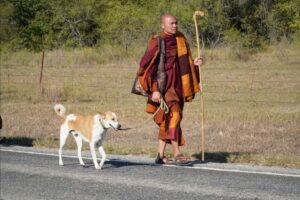
Aloka’s story is also physical and real. Reports note that he required veterinary surgery during the pilgrimage, then recovered and rejoined the group. To many Americans, the dog has become an emotional doorway into the meaning of the walk. People who may not know Buddhist teachings understand loyalty, gentleness, and trust. They wave, smile, donate, and share his story, finding in Aloka a reminder that the world is not only made of conflict and fear, but also of friendship and care.
As the monks continue toward Washington, the Walk for Peace feels less like a journey to a destination and more like a moving reflection on what the country has become and what it still could be. It challenges the modern obsession with speed, consumption, and constant argument. It suggests that healing may begin not in grand speeches but in small choices: to slow down, to breathe, to be kind, to protect one another on the road. The monks are not trying to conquer America. They are simply walking through it, reminding people of an ancient teaching that still feels urgently modern: peace is built one mindful step at a time.
Photos source: Huong Dao Vipassana Bhavana Center