By Lhakpa Gelu Sherpa
In the quiet hills of Richmond, California, where the wind moves gently through rows of prayer flags and the earth rests in a deep, meditative stillness, stands the Gyuto Monastery. Surrounded by rolling green hills, the monastery is not merely a physical structure but a living presence, a place where landscape and consciousness seem to meet.
As one approaches the monastery gate, the transition begins. The noise of the outer world slowly dissolves into the rhythmic sound of spinning prayer wheels. Each turn carries silent mantras into the vastness, as if the wind itself has become a messenger of compassion. A long line of prayer wheels guides the path inward, leading to the great prayer wheel, a monumental symbol of the continuous turning of wisdom and the unfolding of awareness.
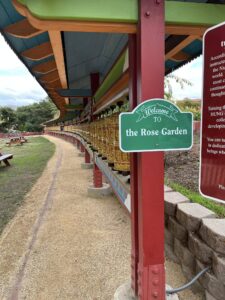
Along this sacred approach, the rose garden unfolds gently, adding color, fragrance, and a quiet sense of welcome. Here, visitors can sit in stillness, breathing in the freshness of the mountain air. Prayer flags flutter softly above, carrying blessings into the open sky, while a variety of flowers bloom in harmony with the landscape. From this peaceful space, the surrounding hills reveal their quiet beauty, inviting reflection and a deeper connection with nature. In this moment, the garden becomes more than a place; it becomes an experience of calm, presence, and subtle joy.
The eight stupas symbolize the life of the Buddha, each one reflecting a sacred moment of awakening and teaching. In the open courtyard, a serene white statue of Avalokiteshvara, the Buddha of compassion, stands as an embodiment of compassion in its purest form. Inside the monastery, the thousand-armed Avalokiteshvara reveals a deeper truth: compassion is never limited, but extends infinitely, reaching all beings in every direction and responding to suffering wherever it arises.
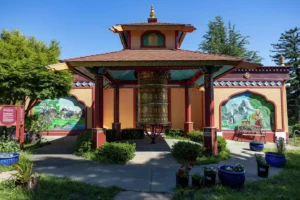
The eight stupas symbolize the life of the Buddha, each one reflecting a sacred moment of awakening and teaching. In the open courtyard, a serene white statue of (Avalokiteshvara), the Buddha of compassion, stands, embodying compassion in its purest form. Inside the monastery, the thousand-armed Avalokiteshvara reveals a deeper truth, compassion is not limited but extends infinitely, reaching all beings in every direction, responding to suffering wherever it arises.
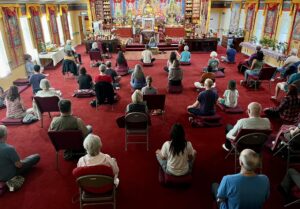
Crossing the threshold into the main hall, one enters a different dimension of experience. A grand statue of the Buddha sits in silent stillness, surrounded by Bodhisattvas whose presence feels both symbolic and immediate. Along the walls hang intricate thangka paintings of the eight great masters of Nalanda University, including Nagarjuna, Aryadeva, Asanga, Dignaga, Dharmakirti, Vasubandhu, Shantideva, and Atisha. Their teachings echo through centuries, reminding us that wisdom is not bound by time, but continues as a living current.
Entering the monastery is not simply a physical act. It is a shift in awareness. Outside, life moves in urgency. Inside, it unfolds in presence.
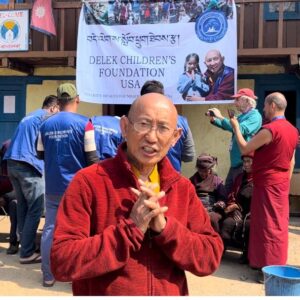
At the heart of this sanctuary is Venerable Thupten Donyo, the founder and director of the Gyuto Foundation and the Delek Children Foundation. His life story reflects the very teachings that the monastery embodies.
Born in the remote region of Solukhumbu, Nepal to a Sherpa father and Tibetan mother, his early life was shaped by simplicity and endurance. Raised largely by his grandmothers, he later walked hundreds of miles with his family to Kathmandu, where survival required both resilience and faith. As a child named Pasang, he attended a Tibetan refugee school near Swayambhu. With only a small amount of money for daily food, he chose not to spend it on himself. Instead, he saved it to offer butter lamps and incense to the Buddha. He collected mud and stones to build small stupas, expressing devotion through action rather than words.
At the age of twelve, he entered monastic life in India at the Gyuto Monastery. There, he underwent rigorous training in Buddhist philosophy and practice. The path was not easy. Discipline was strict, and like many young monks, he faced challenges and hardships. Yet through those experiences, a deeper understanding of mind and life emerged. Upon full ordination, he was given the name Thupten Donyo.
His journey eventually carried him to Australia, and later, in 1997, to the United States. In San Jose, he arrived with almost nothing. Having set aside his monastic robes and dressed in ordinary clothes, he stepped into a world far removed from the life he had once known. He worked first as an auto parts delivery driver, and later as a busboy in a French restaurant in San Francisco. These were not the roles he had imagined for himself, yet they quietly became part of his unfolding path.
With unwavering determination, he saved every dollar he could, guided by a vision far greater than his immediate circumstances, the dream of building a monastery. There were moments of deep hardship, times that tested both body and mind. Yet his perseverance was not driven by desperation alone, but by a profound commitment to a purpose beyond himself.
Gradually, he brought four monks from India, renting a modest space with the support of community members, and began to nurture the early roots of a spiritual community. What started as a humble gathering place slowly evolved through patience, devotion, and quiet perseverance. After years of effort, he was able to establish a permanent center with the support of generous members. As the Himalayan community in the Bay Area continued to grow, so too did the need for a larger space that could hold its expanding spiritual and cultural life.
In time, the small center could no longer contain the aspirations it had awakened. The growing community called for something larger, more enduring. Yet such a vision required immense resources. He began to carry within him the dream of a project worth nearly ten million dollars, not as ambition, but as a necessity shaped by service; however, the funds didn’t materialize.
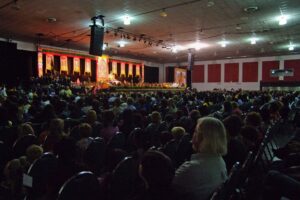
In 2007 and again in 2010, he invited His Holiness the Dalai Lama to the Bay Area to offer public teachings. Those moments became turning points. The monastery, once quiet and largely unseen, began to emerge into wider recognition. Its presence deepened, its purpose became more visible, and its connection to the broader community strengthened.
In 2013, he acquired the current property in Richmond, transforming it into what is now the Gyuto Monastery. The space itself carries a layered history, once a Baptist church, later a Hindu temple, and now a Tibetan Buddhist sanctuary. Over time, it has welcomed many great spiritual leaders, including His Holiness the Dalai Lama, Sakya Trizin, Karmapa, and other respected Rinpoches. Today, it stands as both a spiritual center and a cultural bridge, open to all, regardless of background or belief.
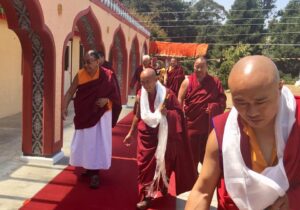
The Gyuto Foundation offers a wide range of Dharma activities. From Medicine Buddha prayers for healing to Tara practices for long life, from Mahakala rituals to Vajrasattva purification ceremonies, each practice serves as a method for transforming the mind. These are not rituals performed in isolation, but collective acts of intention, grounded in the wish to reduce suffering and cultivate wisdom. All programs are open to the public, reflecting the principle that the path of awakening is universal.
Yet the true essence of the monastery extends beyond its walls.
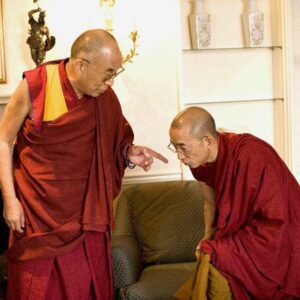
Following the guidance of His Holiness the Dalai Lama, who once advised him not to focus solely on building large monasteries but to serve others, Venerable Thupten Donyo established the Delek Children Foundation. Through this initiative, hundreds of children in Nepal and India have received support in education and healthcare. Many of these students are now pursuing careers in nursing, returning their knowledge to serve others. The foundation has also supported medical outreach programs in remote Himalayan regions, including cataract surgeries in collaboration with renowned humanitarian doctors such as Dr. Sanduk Ruit.
This work reflects a deeper understanding of Buddhism, not as abstract philosophy, but as lived compassion.
“If you live only for yourself, it is a form of selfishness. Think beyond yourself, to your family, society, nations, and the world as a whole. We need greater compassion and awareness. To be born as a human being is precious, the result of positive karma. This life offers us a rare and meaningful opportunity to serve others,” said Venerable Thupten Donyo.
His words carry the essence of interdependence. Life is not an isolated experience. Every action, every thought, every moment is connected to the wider web of existence. To live with awareness is to recognize this connection. To live with compassion is to act upon it.
Within the stillness of Gyuto Monastery, this truth becomes tangible. In time, the center was formally recognized by the state, not only as a place of worship, but as a living space of compassion, learning, and shared human values.
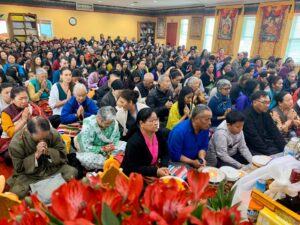
The prayer wheels continue to turn. The scent of incense rises and dissolves into the air. Visitors from different cultures and beliefs arrive, each carrying their own questions, their own burdens, their own hopes. Yet for a moment, all stand within the same quiet space.
And in that silence, something begins to shift.
The monastery is not only a place to visit. It is a reminder. A reminder that compassion is not simply an idea, but a responsibility. A reminder that awareness is not distant, but present in each moment. A reminder that to be human is to have the capacity to care, to serve, and to awaken.
In the gentle stillness of the courtyard, beneath the open sky and the watchful presence of Avalokiteshvara, one begins to understand that the path is not somewhere far away.
It is here.
Photo courtesy: Gyuto Foundation