
Preventing Escalation: Why the Middle East Crisis Must Be Resolved Through Urgent Diplomacy”
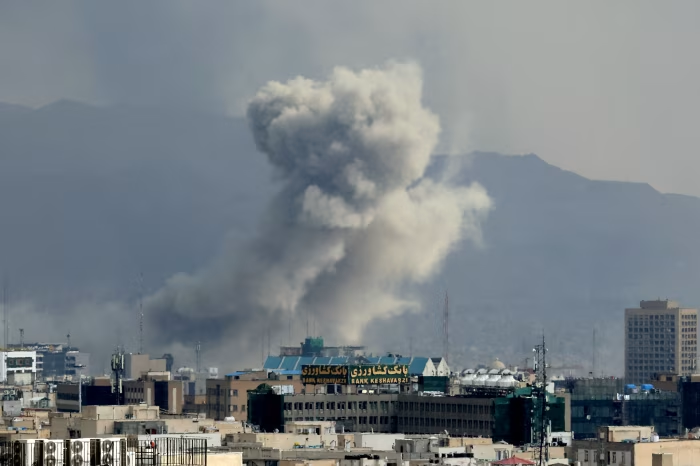
The Middle East remains one of the most geopolitically sensitive regions in the world, where local conflicts often evolve into broader international crises. Over the past decades, tensions among major regional actors and global powers have repeatedly produced cycles of instability that affect not only the region but also the wider global community. In recent years, the confrontation involving Israel, Iran, and the United States has further intensified these tensions. Military exchanges, strategic rivalries, and competing geopolitical interests have raised fears that a localized conflict could expand into a wider regional war. In this context, diplomatic efforts to resolve the Middle East crisis have become not only desirable but urgently necessary.
The roots of the region’s instability lie in complex historical and political developments. Many analysts trace the origins of modern Middle Eastern conflicts to the collapse of the Ottoman Empire, after which external powers redrew political boundaries across the region. These borders frequently overlooked the ethnic, tribal, and religious realities of local populations. Over time, these structural tensions were compounded by ideological rivalries, struggles for regional influence, and unresolved national aspirations. As a result, many countries in the region have faced persistent political instability and periodic armed conflict.
Among the most significant contemporary drivers of regional tension is the strategic rivalry between Israel and Iran. Israel perceives Iran’s expanding missile capabilities and nuclear ambitions as a serious security threat, while Iran views Israeli and American military influence in the region as a challenge to its sovereignty and strategic interests. The involvement of the United States as Israel’s primary security partner has further intensified this confrontation. Military operations, covert actions, and retaliatory strikes have periodically brought the region to the brink of wider war, raising concerns among global leaders about the potential consequences of escalation.
At the same time, the broader Middle East crisis cannot be separated from the longstanding Israeli–Palestinian conflict. The political future of the West Bank and the Gaza Strip continues to be a central issue in regional diplomacy. The absence of a durable political settlement has sustained cycles of violence and contributed to mistrust between communities. Without progress toward a negotiated solution that addresses both Israeli security concerns and Palestinian political rights, broader regional reconciliation will remain difficult.
Given the complexity of these overlapping conflicts, a purely military approach is unlikely to produce lasting stability. Diplomatic engagement therefore remains the most viable pathway toward de-escalation. International institutions such as the United Nations can play a crucial role in facilitating negotiations, encouraging ceasefires, and supporting humanitarian relief efforts. Multilateral diplomatic initiatives that involve regional actors, global powers, and international organizations may help establish mechanisms for dialogue and conflict prevention.
Another essential element of peacebuilding lies in economic cooperation and development. Many societies in the Middle East face significant socioeconomic challenges, including high youth unemployment, economic inequality, and limited opportunities for social mobility. Addressing these structural issues through economic reform, infrastructure development, and regional trade partnerships could reduce the social pressures that often contribute to instability. Economic interdependence can also create incentives for cooperation among states that might otherwise remain adversaries.
Equally important is the role of responsible international engagement. The Middle East has historically been a theater of geopolitical competition among major global powers seeking influence over energy resources, strategic trade routes, and political alliances. While international involvement is sometimes necessary for mediation and humanitarian support, excessive military intervention has often intensified rather than resolved regional tensions. A more balanced approach would prioritize diplomacy, mediation, and long-term reconstruction efforts.
At this critical moment, it is essential that the international community recognize the urgent need for de-escalation. Continued military confrontation between Iran, Israel, and their allies risks producing devastating humanitarian consequences across the region. Civilian populations in multiple countries already face immense hardship due to ongoing conflicts, economic disruptions, and displacement. If tensions continue to escalate unchecked, the number of casualties and the scale of human suffering could grow dramatically.
For this reason, it is my considered opinion that the current crisis must be addressed through immediate diplomatic engagement before the human cost becomes even more severe. Wars rarely produce true solutions; they often deepen grievances and leave societies divided for generations. Preventing further loss of life should therefore remain the highest priority for regional leaders and the international community alike. Negotiation, restraint, and mutual recognition of security concerns offer a far more constructive path than continued escalation.
Ultimately, resolving the Middle East crisis will require patience, compromise, and sustained diplomatic commitment. The region’s conflicts are deeply rooted and cannot be solved overnight. Yet history has shown that even the most entrenched rivalries can gradually evolve through dialogue and cooperation. If political leaders choose diplomacy over confrontation and prioritize the protection of civilian lives, a pathway toward a more stable and peaceful Middle East may still emerge.