
Lumbini: The World’s Greatest Untapped Pilgrimage Destination and Nepal’s Missed Spiritual and Economic Opportunity

In the fertile plains of southern Nepal, where the last ridges of the Himalayas soften into the vast Gangetic lowlands, lies Lumbini, the birthplace of Gautama Buddha. It is here, beneath the quiet canopy of ancient sal trees, that one of humanity’s most transformative journeys began. From this soil emerged a philosophy that challenged suffering, redefined consciousness, and offered a path grounded in compassion, peace, mindfulness, and interdependence. Recognized as a UNESCO World Heritage Site, Lumbini is not merely a heritage site; it is a civilizational origin point. Yet, despite its unparalleled global significance, it remains strikingly underdeveloped, caught between reverence and neglect.
The contradiction surrounding Lumbini is both visible and deeply embedded in Nepal’s national narrative. As a country, Nepal proudly declares to the world, “Buddha was born in Nepal.” This statement echoes across international forums, diplomatic speeches, tourism campaigns, and cultural celebrations. It has become a defining element of national identity, a source of pride, and at times even a means of seeking global recognition, solidarity, and financial support. However, beyond this powerful declaration lies an uncomfortable truth. The same birthplace that is celebrated globally has not been developed with the seriousness, vision, and sustained investment it demands. The pride is emotional and loud, but the policy response remains inconsistent and fragmented. There exists a widening gap between what Nepal proclaims to the world and what it delivers on the ground.
This gap becomes even more striking when viewed in the context of global Buddhism. Today, Buddhism is practiced by an estimated 500 to 550 million people worldwide. From the Theravada traditions of Sri Lanka, Thailand, and Myanmar to the Mahayana cultures of China, Japan, and Korea, and the Vajrayana traditions of Tibet, Bhutan, and the Himalayan regions, millions trace their spiritual lineage back to Lumbini. In principle, this alone should position Lumbini among the most visited pilgrimage destinations on Earth. It should attract millions of international pilgrims annually, not only as tourists, but as seekers, practitioners, scholars, and spiritual travelers. If even a small fraction of this global Buddhist population were to visit Lumbini each year, the scale of economic, cultural, and diplomatic transformation for Nepal would be extraordinary. Yet the current reality falls far short of this potential. Most visitors spend only a few hours at the site, engaging superficially with a place that deserves deep reflection and extended immersion.
Lumbini itself is not a singular monument, but a vast and layered sacred geography. At its center lies the Maya Devi Temple, marking the precise birthplace of Siddhartha Gautama. Nearby stands the Ashokan Pillar, erected by Emperor Ashoka in the third century BCE, providing one of the earliest historical validations of the site. Surrounding these are ancient ruins, sacred ponds, and monastic complexes established by Buddhist communities from across the world, each reflecting different cultural interpretations of the same spiritual tradition. Beyond this central zone, the greater Lumbini region unfolds into an even richer historical landscape. Tilaurakot, believed to be the ancient capital of Kapilavastu, represents the early life of Prince Siddhartha before his renunciation. Devdaha connects to his maternal lineage, while Ramgram preserves one of the original relic stupas of the Buddha, uniquely believed to remain unopened and intact.
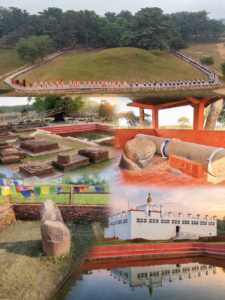
Even more profoundly, the Lumbini region is not limited to the historical Buddha alone. It is part of a broader sacred cosmology that includes earlier Buddhas of the Buddhist tradition. Niglihawa, associated with an Ashokan pillar dedicated to Kanakamuni Buddha, and Gotihawa, believed to be the birthplace of Krakuchhanda Buddha, extend the spiritual narrative beyond a single historical moment. These sites collectively transform Lumbini into a multidimensional pilgrimage landscape, one that spans multiple eras of Buddhist history and offers the potential for a deeply immersive, multi-day journey. Yet, this vast network remains underdeveloped, poorly integrated, and largely unknown to the global audience.
The modern vision for Lumbini’s development was, in fact, conceived at the international level. In the early 1970s, U Thant recognized the global significance of Lumbini and initiated efforts to transform it into a center of peace and global harmony. This vision materialized through the Lumbini Master Plan, designed by renowned Japanese architect Kenzo Tange. The plan envisioned Lumbini as a sacred city structured around harmony, with clearly defined zones for pilgrimage, monastic life, and urban development. To implement this vision, the Government of Nepal established the Lumbini Development Trust, also known as Lumbini Bikas Kosh. While this institutional framework laid a strong foundation, its execution over the decades has remained incomplete, hindered by political instability, bureaucratic inefficiency, and lack of long-term strategic continuity.
The structural challenges facing Lumbini are deeply rooted in Nepal’s political and cultural context. Historically, Nepal functioned as a Hindu kingdom, and even after transitioning into a secular republic, the legacy of this identity continues to influence national priorities and policy directions. In such a landscape, Lumbini, despite its global significance, has often not been treated as a central national priority. Investment has been sporadic, policies have lacked continuity, and development has been fragmented. Frequent changes in government have further weakened long-term planning, while institutional coordination between federal, provincial, and local levels remains limited.
Infrastructure development has taken place, but often in isolation from a broader strategic vision. The construction of the Gautam Buddha International Airport was expected to transform accessibility and attract international pilgrims. However, without effective global marketing, integrated tourism planning, and enriched visitor experiences, the airport has struggled to fulfill its potential. Hotels have been built, roads have been expanded, and facilities have improved, but the absence of a cohesive narrative and structured pilgrimage circuit has prevented Lumbini from evolving into a destination where visitors stay, reflect, and engage deeply.
The economic implications of this underdevelopment are immense. If Nepal were to strategically position Lumbini and its extended sacred circuit as a global pilgrimage destination, even a modest increase in international visitors could generate billions of dollars in economic activity. Millions of pilgrims would create employment, stimulate local economies, strengthen small and medium enterprises, and significantly contribute to national GDP. Lumbini could become a cornerstone of Nepal’s economic transformation, complementing its identity as a destination for Himalayan adventure with a powerful presence in spiritual and cultural tourism. Yet, the current model of short visits and low spending continues to limit these possibilities, reinforcing a cycle of underperformance.
At its core, the issue of Lumbini is not merely about infrastructure, tourism, or economics. It is about vision. Lumbini is not just a destination to be visited; it is a message to be understood. In a world increasingly marked by conflict, environmental crises, and psychological distress, the teachings of the Buddha hold profound relevance. Lumbini has the potential to become a global center for meditation, peace studies, interfaith dialogue, and spiritual education. It can serve as a bridge between ancient wisdom and modern challenges, offering a space for reflection, healing, and transformation.
Lumbini stands today at a decisive moment. It carries within it both a timeless legacy and an unrealized future. The world already recognizes its importance. The pilgrims are there. The history is undeniable. The philosophy is universal. What remains uncertain is whether Nepal can rise to meet this responsibility with clarity, commitment, and courage. If it can, Lumbini will not only transform Nepal’s economy, but also redefine its place in the moral and spiritual imagination of the world.