
UN Member States Commemorate International Day of Vesak with Call for Global Peace and Cooperation
May 1, 2026, New York
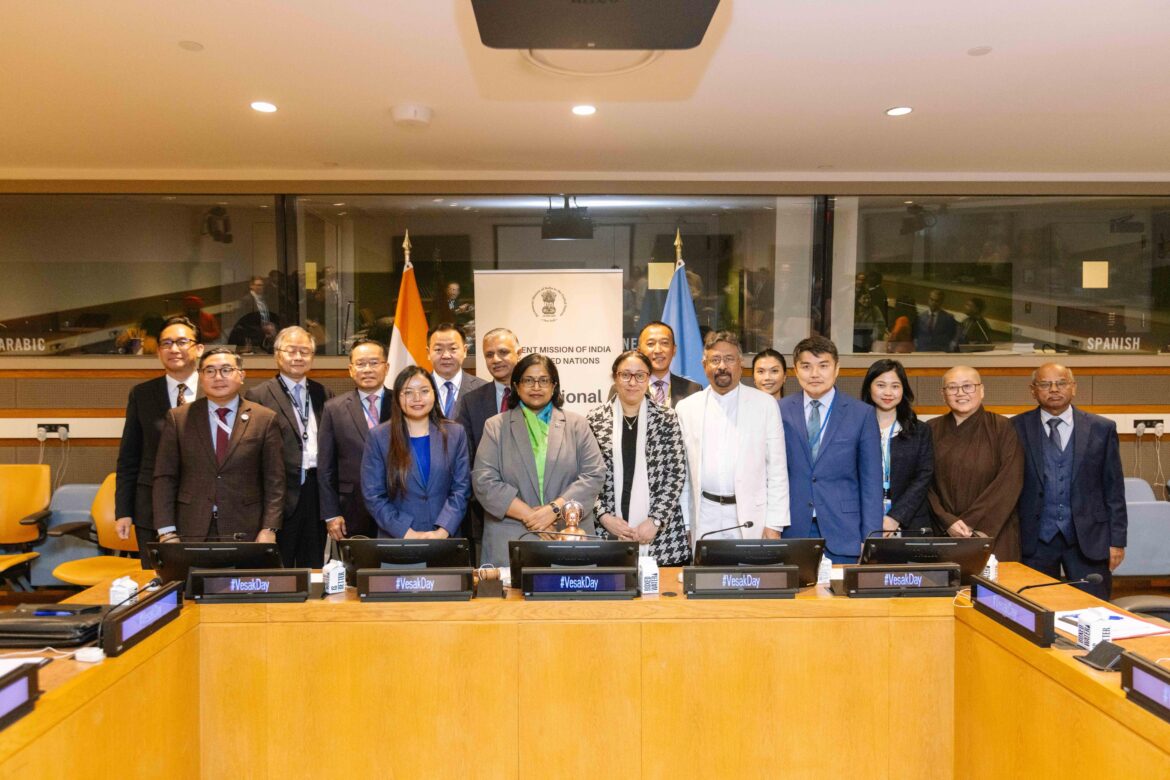
At a time when the world continues to grapple with rising geopolitical tensions, conflict, and deepening divisions, the observance of the International Day of Vesak at the United Nations Headquarters in New York offered a moment of reflection grounded in one of humanity’s most enduring spiritual traditions. On April 30, 2026, the Permanent Mission of India to the United Nations, in collaboration with the Permanent Missions of Sri Lanka, Nepal, Bhutan, Cambodia, Japan, Lao PDR, Mongolia, the Republic of Korea, Thailand, and Viet Nam, convened a high-level panel discussion that brought together diplomats, scholars, and representatives of diverse Buddhist traditions.
The panel centered on the theme, “Leveraging Buddhist Heritage for Strengthening Global Peace and Cooperation,” a subject that resonated deeply with the contemporary global context. Participants explored how shared Buddhist philosophies, cultural exchanges, and centuries-old traditions across Asia and beyond could contribute meaningfully to fostering dialogue, mutual understanding, and collaborative approaches to global challenges.
In her opening remarks, Chargé d’affaires Ambassador Yojna Patel emphasized the profound historical and civilizational connections that bind regions stretching from the Indian Ocean to the Indo-Pacific. She described these connections as rooted not merely in geography, but in a shared legacy of Buddhist art, architecture, philosophical thought, and ethical values that have transcended borders for centuries. Highlighting India’s ongoing efforts, she spoke of initiatives aimed at revitalizing these ancient ties through the development of a comprehensive Buddhist tourism circuit, as well as through the preservation and restoration of sacred heritage sites, monasteries, and archaeological landmarks. These efforts, she noted, are gradually shaping what she described as an “organic transnational spiritual corridor,” linking nations through shared history and spiritual identity.
Delivering the keynote address, Nalanda University Vice Chancellor Sachin Chaturvedi provided a philosophical and policy-oriented perspective, drawing attention to the core Buddhist principles of interdependence and collective well-being. He argued that these timeless ideas remain highly relevant in addressing the complexities of modern global governance. In particular, he called for a shift away from narrowly defined, sector-based development models toward more holistic, human-centered approaches. Such a transformation, he suggested, would better align with the ethical and sustainable dimensions of the United Nations’ development agenda, including the Sustainable Development Goals. By integrating Buddhist philosophical insights into contemporary policymaking, he emphasized the possibility of cultivating systems that prioritize compassion, balance, and long-term sustainability.
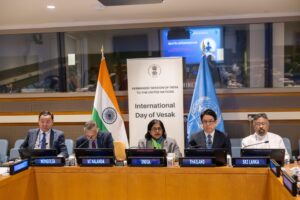 Photo Courtesy: South Asian Herald
Representatives from participating countries further enriched the discussion by highlighting how Buddhist values continue to shape national philosophies and public policies in diverse ways. Bhutan, for instance, pointed to its globally recognized Gross National Happiness framework, which prioritizes well-being over purely economic indicators. Delegates from Japan, Thailand, and Viet Nam underscored the importance of human dignity and moral responsibility, while the Republic of Korea observed a growing interest in Buddhist teachings among younger generations seeking meaning and balance in an increasingly complex world.
Sri Lanka’s Permanent Representative to the United Nations, Jayantha Jayasuriya, offered a deeply historical and spiritual reflection on Vesak itself. He reminded participants that Vesak, observed on the full moon of May, marks the birth, enlightenment, and passing of Lord Buddha—three defining events that continue to inspire millions around the world. Emphasizing the enduring relevance of Buddhist teachings, he highlighted the guiding principles of loving-kindness (Metta), compassion (Karuna), sympathetic joy (Muditha), and equanimity (Upekka) as essential values for addressing conflict, inequality, and human suffering in the modern era.
He also reflected on the transformative role of Ashoka, the ancient Indian emperor who embraced Buddhism and reshaped governance through the promotion of non-violence, moral responsibility, and compassion. Ashoka’s legacy, Jayasuriya noted, extended far beyond his empire, particularly through the historic mission led by his son Mahinda to Sri Lanka. That moment, when King Devanampiyatissa embraced Buddhism, marked a turning point that deeply embedded Buddhist teachings into the cultural and spiritual fabric of Sri Lankan society—a legacy that continues to endure.
Reaffirming Sri Lanka’s commitment, Jayasuriya noted that the protection and promotion of the Buddha Sasana remains a constitutional responsibility of the state, reflecting the enduring significance of Buddhism in national identity and governance.

Photo Courtesy: South Asian Herald
Delegations from Mongolia, Lao PDR, and Cambodia reiterated their strong commitment to the teachings of the Buddha, while Nepal emphasized the importance of the Middle Path—a philosophy of balance and moderation, as a guiding framework for peaceful coexistence in an increasingly polarized world. Across all interventions, a common message emerged: that Buddhist heritage, far from being confined to history, continues to serve as a living bridge between nations, fostering trust, strengthening people-to-people connections, and encouraging cooperative approaches to peace and sustainable development.
The observance of Vesak at the United Nations is rooted in United Nations General Assembly Resolution 54/115, adopted in 1999, which formally recognizes the International Day of Vesak. Observed annually on the first full moon of May, the day commemorates the birth, enlightenment, and passing of the Buddha, while also honoring the profound spiritual and cultural contributions of Buddhism over more than two and a half millennia.
As the world stands at a crossroads marked by uncertainty and division, the message emerging from this year’s Vesak commemoration was clear: the timeless teachings of the Buddha, rooted in compassion, wisdom, and interconnectedness, offer not only spiritual guidance, but also a practical framework for building a more peaceful, cooperative, and sustainable global future.