

How Meditation Cultivates a Mindfulness Brain
In a world dominated by constant stimulation and distractions, cultivating mindfulness through meditation has emerged as a powerful tool for enhancing mental well-being. Mindfulness—the practice of paying full, non-judgmental attention to the present moment—has profound effects on the brain’s structure and function. Decades of neuroscience research reveal that meditation can physically rewire the brain, creating what is often called the “mindfulness brain.” This article explores how meditation fosters these brain changes, grounded in scientific evidence, and how this rewiring translates into practical benefits.
What Is Mindfulness, and How Does Meditation Develop It?
Mindfulness is the intentional awareness of what is happening in the present moment, without trying to change or judge it. It means noticing your thoughts, feelings, bodily sensations, and the environment around you with curiosity and openness.
Meditation, especially mindfulness meditation, is a formal practice designed to cultivate this awareness. Common techniques include:
-
Focused Attention Meditation: Concentrating on a single object such as the breath or a mantra, and gently returning focus when the mind wanders.
-
Open Monitoring Meditation: Observing thoughts, emotions, and sensations as they arise without attachment or reaction.
These practices train the brain to stay anchored in the present moment, reducing habitual patterns of distraction and emotional reactivity.
The Brain’s Plasticity: Foundation for Change
The key to understanding how meditation affects the brain is neuroplasticity—the brain’s remarkable ability to adapt and reorganize itself by forming new neural connections throughout life. Meditation harnesses this plasticity, enabling the brain to strengthen areas involved in attention, emotional regulation, and self-awareness, while weakening areas linked to stress and mind-wandering.
Brain Structures Reshaped by Meditation
-
Prefrontal Cortex (PFC): The Executive Hub
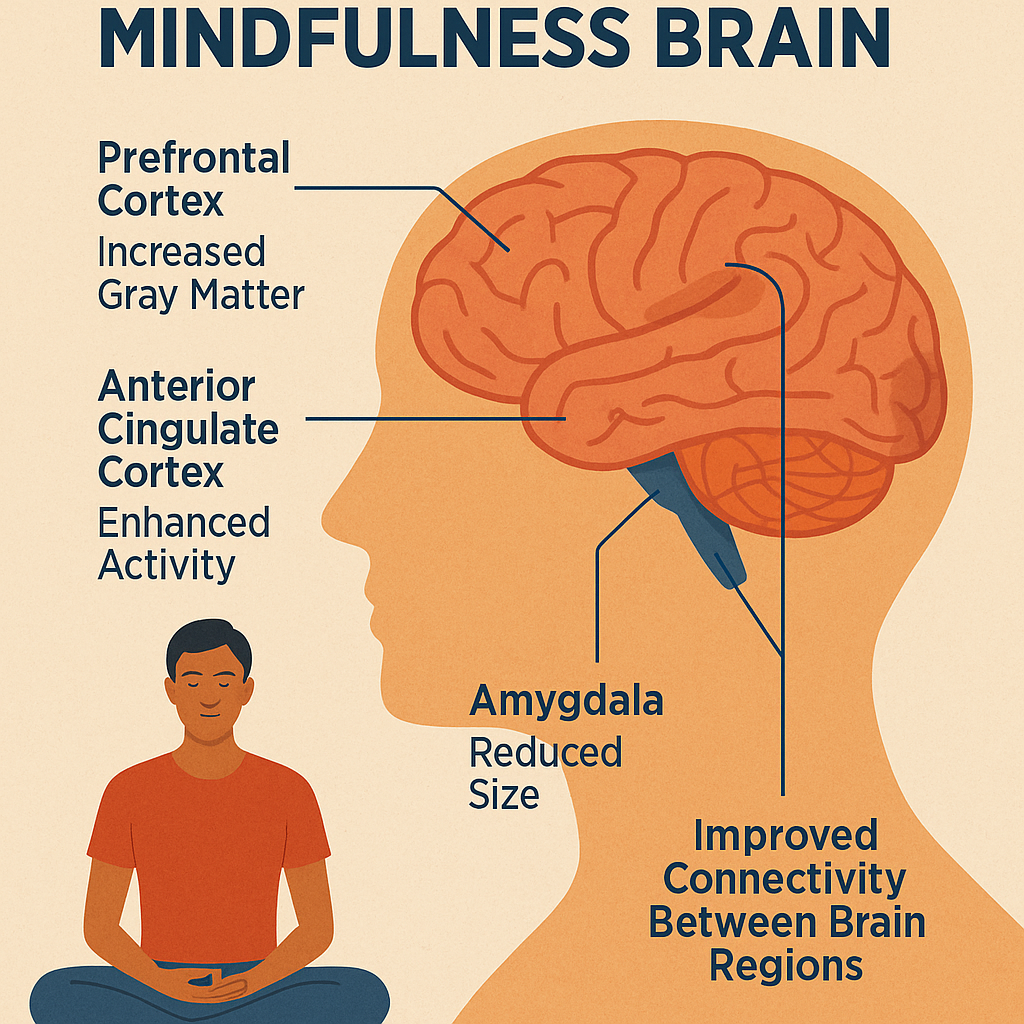
The PFC is the brain’s control center for complex cognitive behavior, including decision-making, attention regulation, and impulse control. Longitudinal studies reveal that regular meditation increases cortical thickness and gray matter volume in the PFC, particularly the dorsolateral and ventromedial regions. This growth enhances:
-
Focused Attention: Improved ability to sustain concentration and ignore distractions.
-
Cognitive Flexibility: Better capacity to switch between tasks or perspectives.
-
Self-Regulation: Enhanced control over impulses and emotional responses.
-
Anterior Cingulate Cortex (ACC): The Attention Regulator
The ACC is involved in error detection, conflict monitoring, and regulating emotional responses. Functional MRI studies show increased ACC activity and connectivity in meditators, allowing them to maintain attention on present-moment experience despite distractions or emotional turmoil. -
Amygdala: The Emotional Alarm System
Responsible for processing fear and stress, the amygdala often triggers the “fight or flight” response. Meditation reduces both the volume and reactivity of the amygdala, as evidenced by MRI scans, which correlates with decreased anxiety, stress hormones (like cortisol), and emotional reactivity. This neural downregulation helps meditators respond calmly under pressure. -
Hippocampus: Memory and Emotion Integration
The hippocampus, critical for memory formation and emotional regulation, shows increased gray matter density after meditation training. This suggests meditation supports the ability to learn from experiences and maintain emotional balance. -
Insula: Interoceptive Awareness
The insula processes bodily sensations and internal awareness. Enhanced insula activity in meditators reflects increased sensitivity to internal bodily states, fostering greater mind-body connection. -
Default Mode Network (DMN): The Mind-Wandering Circuit
The DMN is active during passive rest and self-referential thinking. Overactivity in this network is linked with rumination and depressive symptoms. Meditation has been shown to reduce DMN activity, leading to less mind-wandering, decreased negative thought patterns, and increased present-moment focus.
How Meditation-Induced Brain Changes Translate into Daily Benefits
The structural and functional brain changes fostered by meditation correspond with significant improvements in mental and physical health:
-
Reduced Stress and Anxiety: By decreasing amygdala reactivity and enhancing prefrontal control, meditation helps lower cortisol levels and improve emotional resilience.
-
Enhanced Attention and Focus: Strengthening of the PFC and ACC supports better concentration and reduces susceptibility to distractions.
-
Improved Emotional Regulation: Mindfulness allows recognition and acceptance of emotions without impulsive reaction, decreasing emotional volatility and fostering empathy.
-
Better Sleep Quality: Meditation reduces hyperarousal and rumination, common causes of insomnia.
-
Increased Compassion and Well-being: Mindfulness practice encourages kindness toward oneself and others, contributing to greater life satisfaction and happiness.
Practical Guidance for Cultivating a Mindfulness Brain
-
Start Small and Build Consistency: Research shows that even short, daily meditation sessions (5-10 minutes) can induce positive brain changes over time.
-
Focus on Breath and Body: Direct attention to breath sensations or body scanning to ground awareness in the present.
-
Practice Non-Judgmental Awareness: Notice distractions or emotions as they arise, and gently return to the focal point without self-criticism.
-
Use Guided Meditation or Mindfulness Programs: Structured courses like MBSR or MBCT offer evidence-based protocols to support practice.
-
Integrate Mindfulness in Daily Life: Beyond formal meditation, mindful eating, walking, and listening can reinforce brain plasticity.
Meditation is more than a relaxation technique—it is a powerful neuroplastic process that cultivates a mindfulness brain. By reshaping brain regions responsible for attention, emotion, and self-awareness, meditation equips individuals to navigate life with greater calm, focus, and compassion. As neuroscientific evidence continues to grow, meditation stands out as a scientifically supported method to enhance mental health and cognitive resilience in today’s challenging world.