
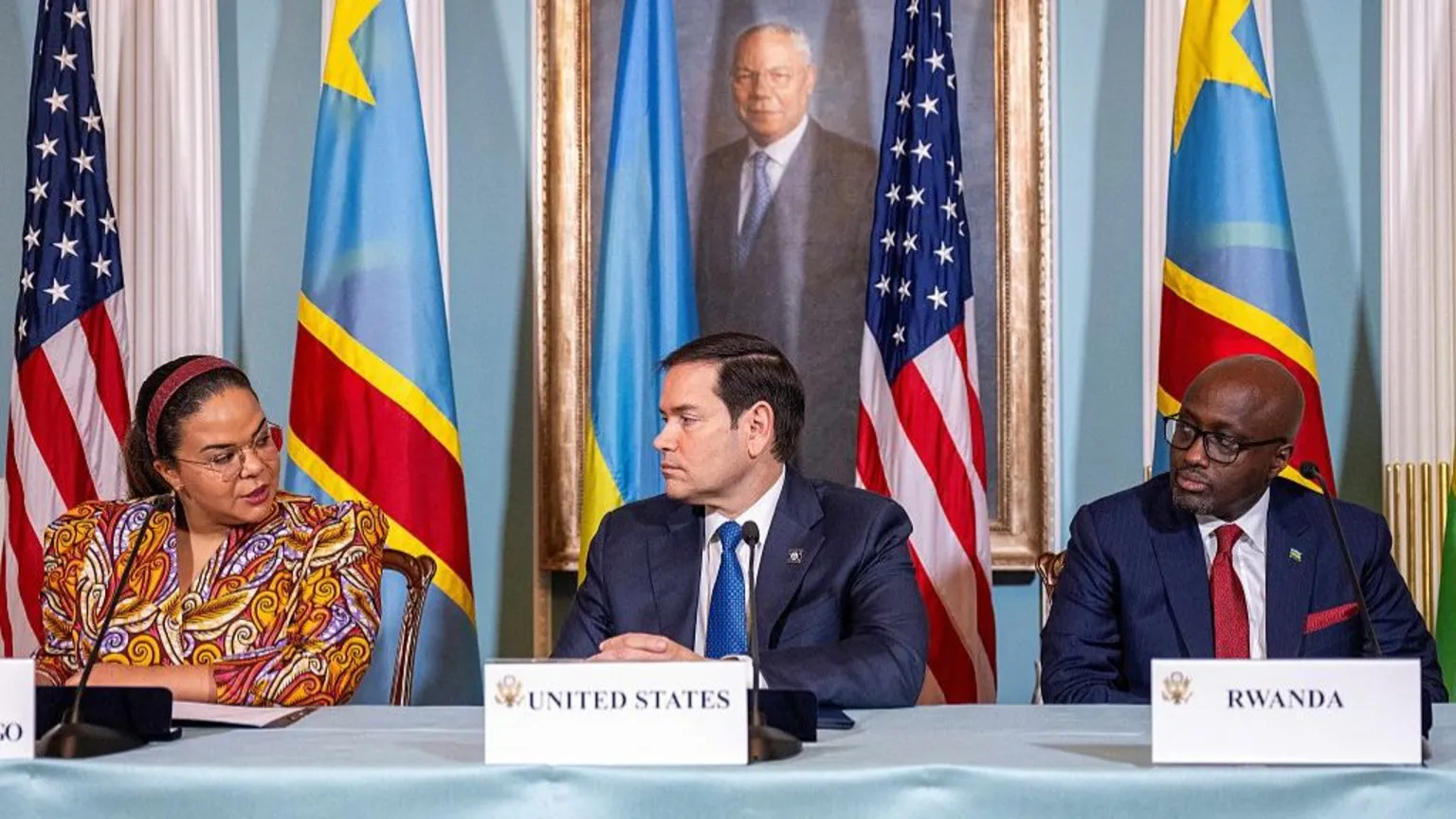
Washington, D.C., June 27, 2025 — In a development hailed by its backers as a “historic breakthrough,” Rwanda and the Democratic Republic of Congo (DR Congo) signed a peace agreement in Washington on Friday, aimed at ending years of violent conflict in eastern Congo that has displaced hundreds of thousands and destabilized the region. The deal also paves the way for deeper U.S. involvement in the region, particularly in securing access to critical minerals.
The agreement calls for the “disengagement, disarmament, and conditional integration” of the numerous armed groups operating in eastern DR Congo, though specific mechanisms for enforcement remain undisclosed. Flanked by top U.S. officials and delegates from both African nations, U.S. President Donald Trump hailed the deal as “a glorious triumph” and “a tremendous breakthrough for peace and prosperity in Africa.”
The ceremony, held in the Oval Office, was attended by Vice President J.D. Vance, Secretary of State Marco Rubio, and the foreign ministers of Rwanda and DR Congo, Olivier Nduhungirehe and Thérèse Kayikwamba Wagner, respectively. The signing followed a “Declaration of Principles” inked in April, which laid the groundwork for this more comprehensive agreement.
Ceasefire Amid Ongoing Tensions
While the signing marks a diplomatic success on paper, skepticism lingers. Previous peace deals in the Great Lakes region have often collapsed under pressure from longstanding mistrust, ambiguous terms, and continued militia activity.
The DR Congo government, led by President Félix Tshisekedi, has faced increasing pressure following the resurgence of the M23 rebel group, which earlier this year captured major areas in eastern Congo, including Goma, Bukavu, and two strategic airports. The fighting has led to thousands of deaths and displaced over half a million civilians.
Eastern Congo holds vast reserves of critical minerals such as coltan—vital for global electronics manufacturing, which many believe played a behind-the-scenes role in encouraging international stakeholders, particularly the U.S., to broker the peace. Reports suggest the Congolese government offered expanded access to these resources in exchange for U.S. security guarantees.
A Contested Presence
One of the thorniest issues remains Rwanda’s military presence in eastern DR Congo. Rwanda has long denied backing the M23 rebels, despite strong evidence to the contrary from the UN and independent sources. Kigali maintains that its presence in the region is strictly defensive, aimed at countering the FDLR (Democratic Forces for the Liberation of Rwanda)—a militia made up primarily of Hutus implicated in the 1994 Rwandan genocide.
DR Congo, on the other hand, accuses Rwanda of violating its sovereignty and demands a full withdrawal of Rwandan troops. However, in the final peace document, references to “Rwandan troops” or “withdrawal” are conspicuously absent. Rwandan Foreign Minister Nduhungirehe emphasized this omission, saying “the words ‘Rwanda Defense Force,’ ‘Rwandan troops,’ or ‘withdrawal’ are nowhere to be seen in the document.”
A last-minute statement from President Tshisekedi’s office acknowledged this semantic gap, saying the deal uses the term “disengagement” instead of “withdrawal” because it is broader and more strategic.
Questions Remain Unanswered
Despite the celebratory mood in Washington, many critical questions remain unanswered:
-
Will M23 fighters actually relinquish control over captured territories?
-
Will Rwanda publicly acknowledge its troop presence and agree to a verifiable pullback?
-
What provisions exist to ensure the safe return of Congolese refugees currently in Rwanda?
-
Who will disarm both the M23 and the FDLR, given past failures?
-
Will humanitarian access be restored to areas currently held by rebels, including airports critical for aid delivery?
A week before the deal, Rwanda lashed out at what it called an unauthorized leak of the draft agreement, accusing other parties of breaching negotiation confidentiality. The final agreement is still not fully public, fueling speculation about undisclosed clauses, especially those involving economic concessions and third-party monitoring.
Regional and International Mediation
Qatar reportedly played a significant role in the lead-up to the deal, dispatching envoys to both Kigali and Kinshasa and hosting face-to-face talks between Presidents Kagame and Tshisekedi. Those meetings led to the formation of a joint committee supported by the U.S., which eventually steered negotiations toward the Washington agreement.
Previous efforts, including those led by Angola, collapsed earlier this year when Rwandan and Congolese ministers failed to endorse two key agreements negotiated by technical teams.
A New Chapter—or Another Missed Opportunity?
President Trump described the agreement as “a new chapter of hope and opportunity” for Central Africa, while President Tshisekedi’s allies are calling it his most significant diplomatic win in over three decades. However, with no clear enforcement mechanism and several unresolved issues, many observers caution that true peace will depend on political will, transparency, and long-term international engagement.
For now, eastern Congo remains volatile, and many on the ground await signs of tangible progress beyond the paper promises made in Washington.