
Tibetan Glacial Lake Drainage Triggered Deadly Bhote Koshi Flood, Says Climate Body
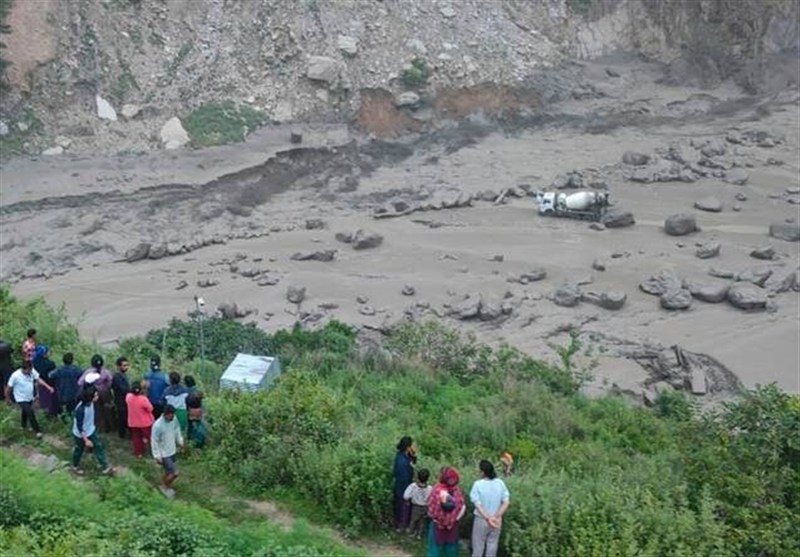
A catastrophic flood that struck Nepal’s Bhote Koshi River this week—killing at least nine people and leaving over two dozen missing—was triggered by the sudden drainage of a supraglacial lake in the Tibet Autonomous Region of China, according to a preliminary satellite-based analysis by the International Centre for Integrated Mountain Development (ICIMOD), a regional intergovernmental climate research body based in Kathmandu.
The disaster unfolded early Tuesday when surging floodwaters washed away critical infrastructure, including the historic Friendship Bridge at Tatopani, which links Nepal’s Sindhupalchok district to China’s Zhangmu town, and inundated several settlements and construction zones along the river corridor.
Among the 19 people still missing on the Nepali side are six Chinese nationals who were working at a Beijing-funded Inland Container Depot site in Larcha. Meanwhile, China’s official state-run Xinhua news agency reported that at least 11 individuals are unaccounted for on the Chinese side of the mountainous border.
“This is based on preliminary analysis using recent satellite imagery,” said Sudan Maharjan, glacier and remote sensing expert at ICIMOD. “The source of the flood appears to be a glacial lake outburst event (GLOF) originating north of Nepal’s Langtang Himal range, in Tibet.”
Supraglacial lakes—formed atop melting glaciers, particularly those blanketed by debris—pose growing risks across the Himalayas. These lakes develop as pockets of meltwater accumulate on glacier surfaces and may expand or coalesce into larger volumes over time. Without proper drainage or natural outlets, they can breach suddenly, unleashing devastating downstream floods.
Saswata Sanyal, another senior scientist at ICIMOD, emphasized that such glacier-lake related hazards are increasing at an “unprecedented pace” across the Hindu Kush Himalaya (HKH) region, which stretches across eight countries: Afghanistan, Bangladesh, Bhutan, China, India, Myanmar, Nepal, and Pakistan.
“We are witnessing more frequent cascading impacts where one climate-related event, such as rapid melting or heavy precipitation, sets off a chain reaction—breaching lakes, triggering floods, destroying infrastructure, and claiming lives,” Sanyal said. “This underscores the urgent need for stronger cross-border monitoring systems and early warning mechanisms.”
Nepal, with its fragile mountainous terrain, is one of the most climate-vulnerable countries in the world. The monsoon season, which runs from June through September, routinely brings extreme rainfall, floods, and landslides, but scientists warn that climate change is now amplifying the scale, unpredictability, and frequency of such events.
The National Disaster Risk Reduction and Management Authority (NDRRMA) of Nepal reported that since the start of the monsoon season on May 29, at least 38 people across the country have either been killed or gone missing due to rain-induced disasters. These include flash floods, landslides, and lightning strikes, particularly in rural and mountainous districts like Rasuwa, Myagdi, and Sankhuwasabha.
With the impact of glacial lake outburst floods (GLOFs) becoming more pronounced, experts stress the need for high-resolution mapping, early warning systems, and transboundary cooperation—particularly between Nepal and China—for monitoring glacial lakes in upstream regions.
The devastating Bhote Koshi flood serves as a stark reminder of the accelerating risks posed by melting glaciers in the era of global warming, and the need for urgent climate adaptation in vulnerable Himalayan communities.