
Taiwan’s Great Recall Vote Fails to Unseat Pro-China Lawmakers, Deepening Political Divide
By HNN News Desk
Taipei, July 26, 2025 —
An unprecedented wave of recall votes in Taiwan aimed at ousting opposition lawmakers accused of aligning too closely with China has failed to remove a single legislator, early results show. All 24 Kuomintang (KMT) lawmakers targeted in Saturday’s high-stakes vote have retained their seats, leaving the opposition’s narrow majority in the legislature intact—for now.
Dubbed the “Dabamian” or Great Recall, the mass vote marked the largest such political action in Taiwan’s democratic history. Citizens in 24 electoral districts cast simple “yes” or “no” ballots on whether their local legislators should be removed from office. The outcome, while still awaiting final tallies in a few districts, confirms that no recall reached the required thresholds: over 25% of eligible voters participating and more than half voting in favor of removal.
The recall was launched by grassroots civic groups—many affiliated with the so-called Bluebird movement—that emerged in response to growing frustration over what they saw as obstructionism and pro-Beijing sympathies among opposition parties.
Origins of the Political Crisis
The political storm brewing over Taiwan’s legislature began in January 2024, when voters elected William Lai of the Democratic Progressive Party (DPP) as president but handed legislative control to the KMT and its allies, including the Taiwan People’s Party and several independents. The result led to months of gridlock, with the opposition blocking DPP-led initiatives and passing controversial bills through its legislative dominance.
This deadlock galvanized thousands of citizens, particularly younger voters and activists, who feared that the KMT’s legislative moves were undermining Taiwan’s democratic integrity and shifting the island closer to Beijing’s orbit. These fears were exacerbated by a visit from several KMT lawmakers to China last year, where they were received by Wang Huning, a top-ranking Chinese Communist Party official.
In May 2024, protests erupted in Taipei, coalescing into the Bluebird movement—a loosely organized coalition of civic groups, students, and democracy advocates. Petitions were launched to recall 31 lawmakers, all of them from the KMT. While both sides accused each other of political manipulation, only 24 districts met the legal threshold to move forward with a vote this July. Seven more districts are expected to hold recall votes in August.
Fierce Campaigns, Divided Society
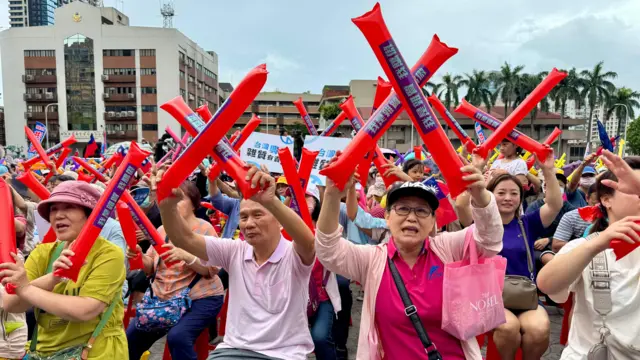
Over the past several weeks, Taiwan has witnessed an intense political campaign that reached deep into every corner of society. Pro-recall activists canvassed neighborhoods, rallied in major cities, and flooded social media with calls to “protect Taiwan from Chinese influence.” Anti-recall voices, largely aligned with the KMT, framed the vote as an attempt by the DPP to overturn the democratic outcome of the January elections.
Although the DPP initially distanced itself from the recall movement, party leaders—including President Lai—eventually embraced it. Lai declared the DPP must “align with the power of the people” and directed officials to support efforts to “defend the nation.”
On the other side, the KMT accused the DPP of orchestrating a power grab under the guise of democracy. Party leaders said the recall was politically motivated and aimed at weakening the opposition majority through illegitimate means.
Political Stakes and International Attention
Saturday’s vote had the potential to shift the balance of power in Taiwan’s Legislative Yuan, which remains a crucial battleground for both domestic reform and international posture. The outcome is being closely watched not only in Taipei but also in Beijing and Washington.
China’s Taiwan Affairs Office harshly criticized the recall movement, accusing President Lai of “engaging in dictatorship under the guise of democracy” and using state resources to “suppress the opposition.” Beijing has long viewed the KMT more favorably than the pro-independence DPP, though the KMT denies being beholden to Chinese interests.
Despite the failure of the Great Recall to remove any lawmakers, political analysts say its impact on Taiwanese politics is profound. The campaign has widened ideological rifts, mobilized younger voters, and intensified public scrutiny of lawmakers’ China policies.
“If the goal was to shake the foundations of political complacency and ignite a national conversation about Taiwan’s democratic future, then the Great Recall has already succeeded,” said Dr. Mei-Ling Hsu, a political scientist at National Taiwan University.
With another round of recall votes slated for August and tensions showing no sign of abating, Taiwan’s political landscape remains volatile—and its democracy as contested as ever.