
At the Edge of Silence: Saving Language and Identity in the Himalayas

In the high valleys of the Himalayas, where prayer flags flutter against snow-laden winds and ancient languages echo through monasteries and mountain homes, a quiet crisis is unfolding. It is not marked by sudden catastrophe, but by gradual disappearance. Languages are fading, traditions are thinning, and identities are being reshaped under the weight of modernity. For Himalayan communities, the challenge today is not simply how to adapt to change, but how to survive within it without losing the very essence of who they are.
Culture, often misunderstood as a static inheritance of rituals and festivals, is in fact a living system. It is the collective expression of a people’s history, knowledge, values, and worldview. Language stands at its core. It is through language that stories are told, spiritual teachings are transmitted, and ecological wisdom is preserved. When a language disappears, it is not merely a linguistic loss; it is the erasure of an entire way of understanding the world.
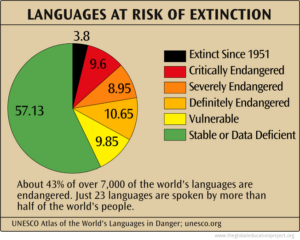
The scale of this crisis is alarming. According to the United Nations and UNESCO, there are approximately 7,000 languages spoken worldwide today. Of these, nearly 40 percent are endangered. More critically, scientific projections suggest that one language disappears approximately every two weeks, and if current trends continue, between 50 to 90 percent of the world’s languages could vanish by the end of the 21st century. In the past hundred years alone, over 600 languages have already gone extinct. These figures are not abstract statistics; they represent the gradual erosion of human diversity.
The Himalayas are particularly vulnerable within this global pattern. Relatively small populations speak many Himalayan languages and often lack standardized scripts, formal education systems, and institutional support. While languages with fewer than 10,000 speakers are generally considered at higher risk, linguistic vitality depends not only on population size but also on intergenerational transmission. In many Himalayan communities, this transmission is rapidly weakening, as younger generations increasingly adopt dominant national and global languages. As a result, even languages with larger speaker bases may face a gradual decline if they are no longer actively passed on to children.
The forces driving this transformation are complex and deeply intertwined. Migration has emerged as one of the most powerful agents of change. Across Nepal, India, Bhutan, and Tibet, as well as within the global diaspora, Himalayan communities have increasingly moved from remote villages to urban centers and foreign countries in search of education, employment, and security. While migration has brought economic opportunities and global exposure, it has also disrupted traditional systems of cultural transmission. In many families, the mother tongue is no longer the primary language of communication. Children grow up speaking dominant languages, English, Nepali, Hindi, or Mandarin—while their ancestral languages become secondary, fragmented, or altogether absent. What begins as adaptation often ends in loss.
Closely tied to migration is the process of acculturation. As communities integrate into dominant societies, they inevitably absorb new cultural norms and practices. This exchange is not inherently negative; cultures have always evolved through contact. However, when the balance shifts too far, assimilation replaces adaptation. Traditional attire is worn only during festivals, rituals are abbreviated or abandoned, and oral traditions, once the lifeblood of Himalayan culture, fade into obscurity. The pressure to conform, particularly among younger generations, often leads to the internalization of a hierarchy in which local languages and traditions are seen as less valuable than global ones.
Education systems have further accelerated this shift. Across much of the Himalayan region, formal education is delivered almost exclusively in national or international languages. While this opens doors to broader opportunities, it also marginalizes indigenous languages. Children are taught to read and write in languages other than their mother tongue, while their mother tongue remains confined to informal contexts. Over time, this creates not only linguistic erosion but also a subtle sense of cultural inferiority. When a language is excluded from education, it is implicitly excluded from legitimacy.
Economic transformation has added another layer of complexity. Traditional livelihoods, pastoralism, subsistence agriculture, and local trade are increasingly replaced by wage labor, tourism, and urban employment. In this shift, cultural knowledge that once held practical value becomes economically invisible. The rhythms of seasonal migration, the knowledge of landscapes, and the rituals tied to agricultural cycles all begin to lose relevance in a market-driven world. Culture, once a way of life, risks becoming a symbolic artifact.
The rise of global media and digital technology has further intensified this transformation. Young people in Himalayan communities today are more connected than ever before—but often to a cultural world far removed from their own. Global entertainment, social media, and digital communication promote dominant languages and lifestyles, subtly reshaping aspirations and identities. While technology offers powerful tools for preservation, it also accelerates cultural homogenization when local content is absent or undervalued.
The consequences of this cultural and linguistic erosion are profound. The loss of language leads to the loss of identity, weakening the bonds that hold communities together. More critically, it results in the disappearance of indigenous knowledge systems, centuries-old understandings of ecology, medicine, and sustainable living that are deeply embedded in Himalayan cultures. At a time when the world is grappling with climate change, such knowledge is not only culturally significant but globally relevant.
Yet, this is not a story of inevitable decline. It is a call to action.
Preserving Himalayan culture requires more than sentiment; it demands structural change and collective responsibility. Education systems must embrace multilingual approaches that allow children to learn in their mother tongues while also gaining access to national and global languages. Families must recognize their role as the first guardians of language, ensuring that cultural transmission begins at home. Community organizations, monasteries, and cultural institutions must actively create spaces where traditions are practiced, not merely performed.
Equally important is the engagement of the younger generation. Preservation cannot be imposed; it must be embraced. Young people must be empowered to carry their culture forward in ways that resonate with their realities through art, literature, media, and leadership. Culture must not remain confined to the past; it must evolve without losing its roots.
Governments, too, bear responsibility. The recognition and protection of minority languages, investment in cultural programs, and inclusion of indigenous knowledge in policy frameworks are essential steps toward safeguarding cultural diversity.
Ultimately, the question facing Himalayan communities is not whether change will occur; it already has. The question is whether that change will lead to cultural erasure or cultural resilience.
At the edge of silence, where languages begin to fade and traditions grow fragile, the future of Himalayan identity hangs in balance. What is at stake is not only the heritage of a region, but the richness of human diversity itself.
If a language disappears, a world disappears with it. The Himalayas, with their profound cultural and spiritual legacy, must not become a place where echoes replace voices

Shechen Center New York Opens, Bringing a Living Buddhist Lineage to the Heart of New York City
1 week ago