

The 30th United Nations Climate Change Conference (COP30) opened this week in Belém, the gateway to the Amazon rainforest, where leaders from nearly 200 nations gathered to confront the accelerating climate crisis. Yet the notable absence of top leaders from the world’s three largest greenhouse gas emitters — the United States, China, and India — immediately cast a shadow over the summit’s ambitions.
While Beijing and New Delhi dispatched senior delegations, the White House confirmed that no high-ranking U.S. officials would attend. President Donald Trump, who has long dismissed human-driven climate change as a hoax, decided against sending representatives to the pivotal talks.
In contrast, U.S. state-level leaders stepped in to represent domestic climate efforts abroad. California Governor Gavin Newsom and New Mexico Governor Michelle Lujan Grisham arrived in Brazil to showcase subnational initiatives aimed at cutting emissions and transitioning to clean energy.
At a global investors meeting in São Paulo, Newsom expressed frustration with the federal administration’s decision to disengage. “What the hell is going on here?” he asked pointedly. “We’re in Brazil, one of our great trading partners, one of the world’s great democracies, and home to the rare earth metals critical for our clean energy transition. This is a country we should be partnering with, not punishing with 50 percent tariffs.”
A Decade After Paris, the 1.5°C Goal Slipping Away
This year’s COP30 marks a sobering milestone, ten years since the landmark Paris Agreement was adopted at COP21, committing 195 nations to limit global temperature rise to well below 2°C and ideally to 1.5°C above pre-industrial levels. The United States, under President Obama, played a leading role in crafting that agreement.
A decade later, scientists warn that the 1.5°C target may no longer be achievable. According to the latest assessments, national climate pledges submitted this year put the planet on a path toward roughly 2.5°C or 4.5°F of warming by the end of the century, a trajectory that would bring increasingly severe droughts, floods, wildfires, and displacement.
The year 2024 was the hottest on record since global temperature tracking began in 1880, and the past decade ranks as the warmest ever recorded.
Despite these grim statistics, U.N. Climate Change Executive Secretary Simon Stiell offered a cautious note of optimism. “For the first time, we are bending the curve of planet-heating emissions downward,” he told delegates. “But I am not sugarcoating it, we have so much more work to do.”
Emissions Reductions Far Short of What’s Needed
A new U.N. analysis released during COP30 indicates that if nations meet their current pledges, global emissions would fall about 12 percent by 2035 compared to 2019 levels. That is an improvement from last month’s projection of 10 percent. However, scientists stress that a 60 percent reduction is needed to keep warming within the 1.5°C threshold.
U.N. Secretary-General António Guterres warned that surpassing this limit would constitute a moral failure and deadly negligence, endangering billions of lives worldwide. He accused fossil fuel companies of holding back change while continuing to reap record profits and government subsidies.
Brazil’s Push for Rainforest Protection and Global Climate Finance
As host nation, Brazil is using COP30 to spotlight the Amazon and its global significance. A new Brazil-led proposal seeks to raise 125 billion dollars to protect tropical rainforests, which are vital carbon sinks but increasingly threatened by deforestation and fires.
Delegates are also expected to discuss expanding financial support for developing countries, which face mounting climate impacts despite contributing the least to global emissions. Wealthy nations are under pressure to deliver on their past commitments and establish reliable funding mechanisms for climate adaptation and mitigation.
At last year’s COP29 in Baku, Azerbaijan, countries set an aspirational target of mobilizing 1.3 trillion dollars annually by 2035, with at least 300 billion from developing economies. But transparency over actual disbursements remains poor, leaving negotiators in Belém facing tough discussions about accountability and equity.
California Steps In as Washington Steps Back
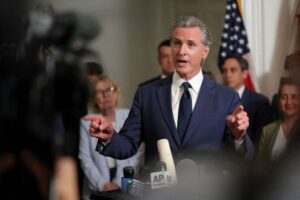
For Governor Newsom, the U.S. absence at COP30 underscores a deepening rift between state and federal leadership on climate policy. California, now the world’s fifth-largest economy, has committed to achieving carbon neutrality by 2045 with aggressive targets for renewable energy, electric vehicles, and green technology innovation.
“California will not wait,” Newsom said in Brazil. “If Washington won’t lead, the states will.”
As the Amazon’s humid air and rising heat framed the first days of COP30, the message was clear. While political divisions persist, the planet’s climate clock continues to tick faster than ever.