
Buddhist Worldwide Begin Observance of Saka Dawa, the Holiest Month in the Buddhist Calendar

May 28, 2025 – Kathmandu, Nepal — Today marks the beginning of Saka Dawa, the holiest month in the Tibetan Buddhist calendar. This sacred period honors the three most significant events in the life of Buddha Shakyamuni: his birth, enlightenment, and parinirvana (passing into final nirvana). It is a time of profound spiritual focus, purification, and compassion, grounded in the belief that any meritorious actions during this month are multiplied a hundred million times.
Saka Dawa is observed from May 28 to June 25, 2025, according to the Tibetan lunar calendar. Its most powerful day, Saka Dawa Düchen, falls on the 15th lunar day, corresponding to June 11 this year. On this full moon day, Tibetan Buddhists believe that all three of the Buddha’s transformative life events occurred, making it an especially auspicious time for practice.
How Saka Dawa Differs from International Buddha Jayanti (Vesak)
While Buddha Jayanti, also known as Vesak, is celebrated by Buddhists across South and Southeast Asia, including Nepal, India, Sri Lanka, Thailand, Myanmar, China, Korea, Burma, Vietnam, Taiwan, Cambodia, and Indonesia, it primarily commemorates the birth of the Buddha, and is based on the Indian lunar calendar. It is typically observed on the full moon of the Vaisakha month, which usually falls in April or May.
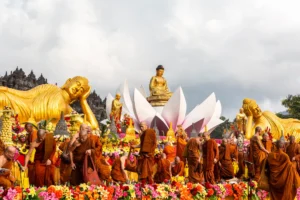
In contrast, Saka Dawa follows the Tibetan lunar calendar, and its timing rarely aligns with Vesak. However, once every three years, the lunar cycles harmonize, and both Saka Dawa Düchen and Vesak fall on the same day, offering a rare moment of unity across Buddhist traditions.
What sets Saka Dawa apart is its month-long observance, inviting practitioners to undertake sustained spiritual discipline, engage in acts of compassion, and cultivate inner transformation. It is not just a commemorative holiday but a continuous spiritual retreat woven into everyday life.
The name Saka Dawa is derived from the Saka star, which appears prominently during this time, and “Dawa”, the Tibetan word for “month.” Its alignment with the 15th day of the 4th Tibetan lunar month marks one of the most spiritually powerful periods in the Tibetan Buddhist year.
While Buddha Jayanti remains an internationally recognized celebration of the Buddha’s life, Saka Dawa offers a deeper immersion into the living practice of the Dharma, not only honoring the Buddha but striving to embody his wisdom in everyday life.
Sacred Pilgrimage and Practice in Kathmandu, Nepal: The Kora Tradition
In Kathmandu, the spiritual intensity of Saka Dawa is most visible around sacred Buddhist sites. Each morning, thousands of Tibetans, Sherpas, Tamangs, Newars, and Nepali Buddhists — joined by international pilgrims- perform kora, or ritual circumambulation, around the Boudhanath Stupa and Swayambhunath Stupa.
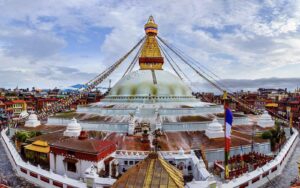
Chanting mantras such as “Om Mani Padme Hum” and “Om Muni Muni Maha Muni Shakyamuniye Soha,” pilgrims walk clockwise, spinning prayer wheels, lighting butter lamps, and offering incense and flowers. Each step becomes a meditative act of devotion and purification, a living prayer in motion.
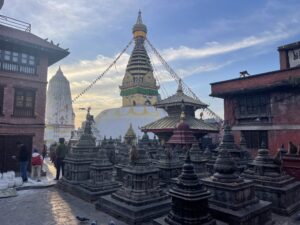
Many devotees extend their journey by undertaking a day-long pilgrimage to Kathmandu Valley’s three great stupas: Boudhanath, Swayambhunath, and Namo Buddha, the latter believed to be the place where the Buddha, in a previous life, offered his body to a starving tigress. Performing this sacred circuit on Saka Dawa Düchen is believed to bring immense spiritual merit.
In Tibet:
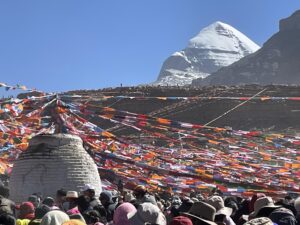
Tibet is considered the spiritual heartland of the Saka Dawa celebration. Despite the limitations imposed under Chinese rule, the festival continues to be deeply revered and widely observed by Tibetan Buddhists. In the capital city of Lhasa, both public and private observances take place with strong devotion and resilience. One of the most notable practices is the kora, or ritual circumambulation, around sacred sites such as the Jokhang Temple and Barkhor Street. Many pilgrims also travel to Mount Kailash, where they perform full-body prostrations in a show of deep spiritual dedication, as the mountain is regarded as the holiest pilgrimage site during Saka Dawa.
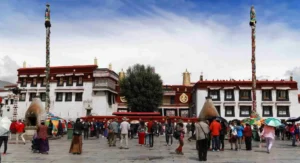
Prayer and offerings are central to the celebration. People light butter lamps, burn incense, and make offerings at temples and shrines across Tibet. Special pujas (rituals) and chanting ceremonies are performed in monasteries, uniting communities in prayer and reflection. The festival emphasizes the practice of accumulating merit, with people engaging in acts of generosity, non-violence, and compassion. Many Tibetans choose to abstain from meat during this period, release animals into the wild, offer alms to the needy, and participate in various forms of kindness and charity. A striking feature of the celebration at Mount Kailash is the raising of a giant prayer flag pole at Tarboche, a powerful symbol of devotion that draws pilgrims from across the Himalayan region.
In India:
In India, Saka Dawa is celebrated with great reverence in regions that have significant Tibetan and Himalayan Buddhist populations. This includes areas such as Ladakh, Himachal Pradesh (particularly Dharamshala), Sikkim, and Arunachal Pradesh, as well as various Tibetan settlements across the country. In Dharamshala, the seat of the Dalai Lama and the Tibetan government-in-exile, the Tsuglakhang Temple becomes the focal point of large gatherings. Here, devotees participate in special prayers, teachings, and meditative sessions such as thukdam.
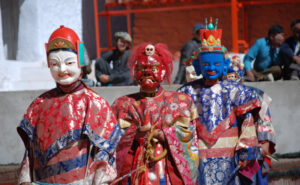
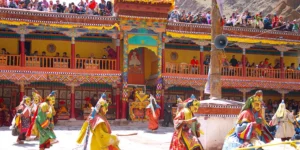
In Ladakh, monasteries like Hemis, Thiksey, and Diskit host vibrant celebrations that include ritual dances, lamp offerings, and public Dharma teachings. Locals actively engage in community service, and many participate in the compassionate act of animal release. In Tibetan settlements like Mundgod and Bylakuppe, monasteries hold grand pujas, debates, and monastic processions, and often offer free vegetarian meals to the public. Meanwhile, in Sikkim and Arunachal Pradesh, monasteries such as Rumtek become pilgrimage centers, with local Buddhist communities organizing prayer gatherings and cultural performances that reflect the rich spiritual and cultural tapestry of the festival.
Common Saka Dawa Practices
Throughout the month, Tibetan Buddhists are encouraged to dedicate themselves to ethical living, meditation, and altruism. Common practices include:
-
Refraining from eating meat to protect life and practice compassion.
-
Offering donations to monasteries, nunneries, and those in need.
-
Reciting sacred texts and mantras, especially Om Mani Padme Hum and the Buddha Shakyamuni mantra.
-
Circumambulating holy sites, such as stupas and temples.
-
Lighting butter lamps symbolizes wisdom dispelling ignorance.
-
Performing prostrations to cultivate humility and devotion.
-
Releasing animals destined for slaughter, promoting non-violence.
-
Taking the Eight Mahayana Precepts on full and new moon days, committing to spiritual discipline for 24 hours.
The Eight Mahayana Precepts
On Saka Dawa Düchen and the 30th lunar day (new moon), many take the Eight Mahayana Precepts, a powerful one-day vow to live with heightened awareness and virtue. The precepts include:
-
Refraining from killing, even insects.
-
Refraining from stealing.
-
Refraining from sexual activity.
-
Refraining from lying or deceiving.
-
Refraining from intoxicants.
-
Eating only one meal before noon.
-
Avoiding luxurious beds or seats.
-
Avoiding adornments, singing, dancing, and entertainment.
While traditionally taken under the guidance of a teacher, anyone with sincere motivation can observe these vows during Saka Dawa.
Teachings and Deep Retreats
Buddhist teachers, such as Rinpoches, have long emphasized the spiritual power of Saka Dawa, encouraging disciples to engage in intensive retreats and dedicated practice. Some of the most recommended activities include:
-
Nyung-Nä retreats involve fasting, silence, and Avalokiteshvara meditation.
-
Buddha Shakyamuni Puja, a ritual involving offerings, chanting, and reflection.
-
Dedicating all positive actions for the benefit of all sentient beings.
A Global Month of Awakening
As Saka Dawa 2025 unfolds, from the bustling kora paths of Kathmandu to the tranquil monasteries of Ladakh, Dharamsala, Lhasa, Mt. Kailash, and beyond, millions of Buddhists around the world are united in their aspirations for peace, liberation, and universal compassion.