
In Observance of Saka Dawa, United Sherpa Association Hosts Three-Day Six-Syllable Mantra Recitation in New York
Lhakpa Gelu Sherpa, Elmhurst, Queens
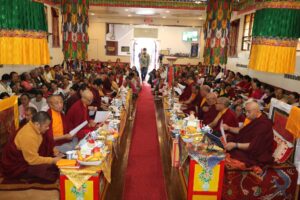
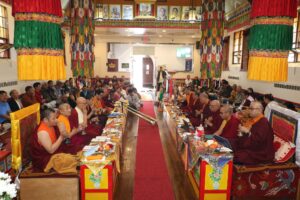
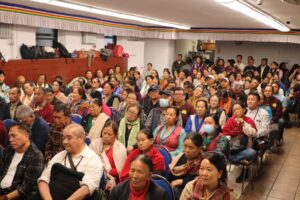
In observance of Saka Dawa, the most sacred month in the Tibetan Buddhist calendar commemorating the birth, enlightenment, and parinirvana of the Buddha, the United Sherpa Association (USA) Inc. hosted a deeply meaningful three-day spiritual gathering in Elmhurst, Queens. Centered on the recitation of the Six-Syllable Mantra, Om Ma Ni Pad Me Hum, the event drew hundreds of practitioners and well-wishers from the Himalayan Buddhist diaspora and beyond.
The Six-Syllable Mantra: An Invocation of Compassion and Wisdom:
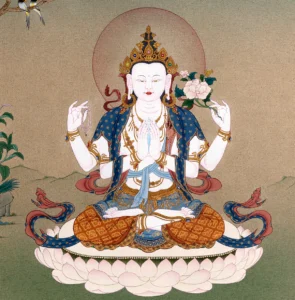
Regarded as the heart mantra of Avalokiteshvara (Chenrezig), the Bodhisattva of Compassion, Om Ma Ni Pad Me Hum is a profound expression of the Mahayana path, blending devotion, meditation, and wisdom. Each syllable carries a transformative potential, purifying specific afflictions and awakening innate virtues:
- Om – purifies pride and ego, linked to the god realm, and evokes the wisdom of equanimity.
- Ma – purifies jealousy and lust for entertainment, related to the jealous gods (asuras), and cultivates wisdom free of comparison.
- Ni – purifies desire and attachment, associated with the human realm, leading to the development of discriminating wisdom.
- Pad – purifies ignorance and delusion, from the animal realm, and reveals the mirror-like wisdom.
- Me – purifies possessiveness and greed, tied to the hungry ghost realm, and nurtures wisdom of accomplishment.
- Hum – purifies hatred and aggression, associated with the hell realms, and manifests all-accomplishing wisdom.
In Buddhist philosophy, this mantra is not simply a prayer, but a method of mental training that cultivates the Bodhicitta—the mind that seeks enlightenment for the benefit of all sentient beings. Reciting it with genuine intent purifies the six kleshas (mental afflictions) and liberates beings from samsara, the endless cycle of suffering.
Teachings and Collective Prayers
The first two days of the program were devoted to the collective recitation of the Six-Syllable Mantra and teachings by highly respected masters of the Himalayan Buddhist tradition. Lopen Gyurme Chhodrak and Khenpo Ngawang Sangay led the sessions with deep spiritual presence, guiding participants through the profound meanings embedded within each syllable of the mantra.
They were joined by Khenpo Ngawang Chhuldrum, Dr. Yula Sherpa, and a group of venerable monks from across the Himalayan region. Together, they enriched the gathering with layered interpretations and spiritual practices that go beyond textual understanding.
Through their teachings, Lopen Gyurme Chhodrak and Khenpo Ngawang Sangay emphasized how the mantra serves not just as a sacred sound, but as a method of transforming the mind. They highlighted how cultivating compassion, developing mindfulness, and practicing ethical discipline are essential for embodying the mantra’s wisdom in daily life. Their words helped bridge ancient teachings with modern living, offering participants not only spiritual inspiration but also practical guidance for navigating the challenges of contemporary life.
A Sacred Presence: His Eminence the 42nd Shakya Ratna Vajra Rinpoche
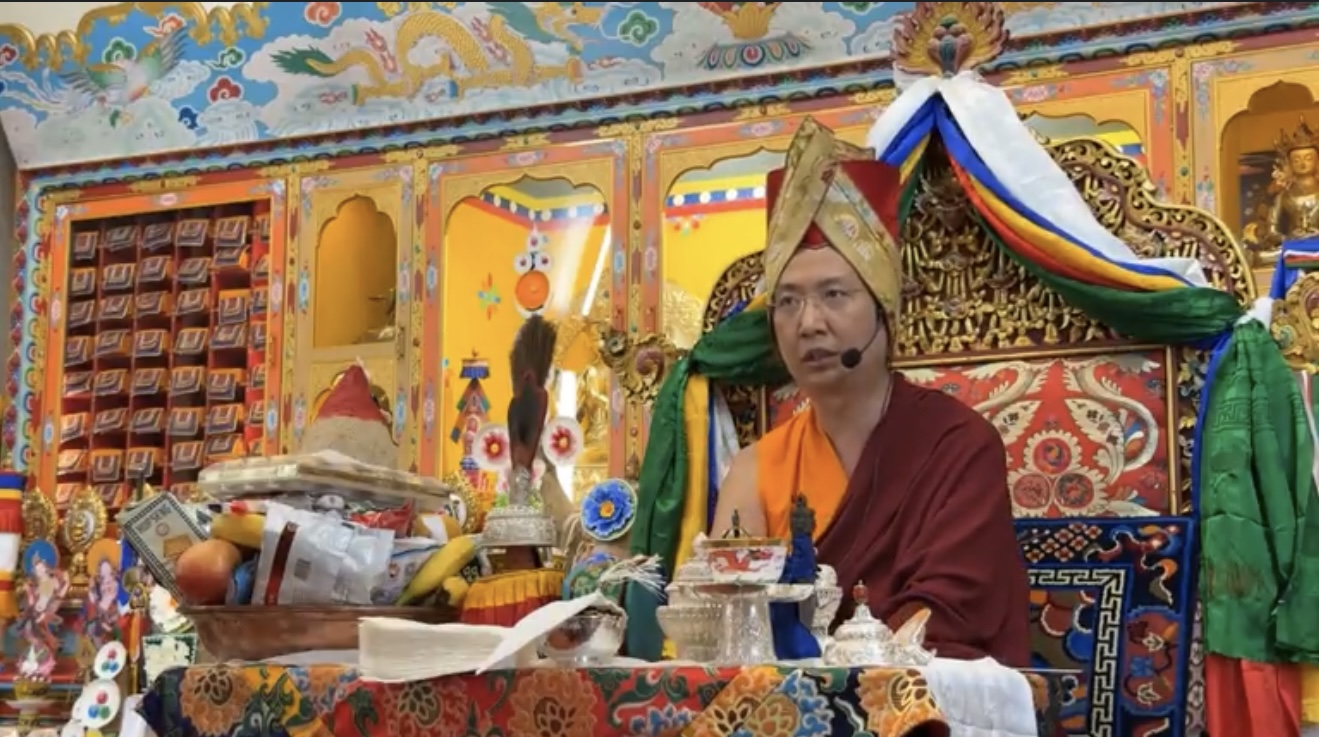
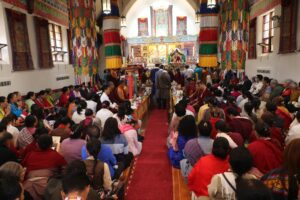
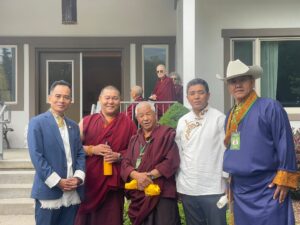
The final day of the Saka Dawa chanting retreat culminated in a moment of spiritual gravity and heartfelt devotion, the arrival of His Eminence, the 42nd Shakya Ratna Vajra Rinpoche. A luminous figure in the Sakya school of Tibetan Buddhism, Rinpoche’s presence infused the gathering with reverence, calm, and radiant purpose. For many in attendance, this was not merely a ceremonial visit but an inner -deep encounter with lineage, wisdom, and living compassion.
One of the most profound teachings Rinpoche shared that day was the timeless instruction known as the Four Attachments, a foundational teaching in the Sakya tradition and a compass for Mahayana practitioners seeking the Bodhisattva path. First revealed in a vision to the great Sakya patriarch Sachen Kunga Nyingpo by the wisdom bodhisattva Manjushri, these four lines distill the essence of the spiritual journey, guiding practitioners away from illusion and toward awakening.
The first attachment states, “If you are attached to this life, you are not a true Dharma practitioner.” Rinpoche explained that clinging to the comforts, status, and fleeting joys of worldly life distracts the mind from the deeper path of liberation. True Dharma begins when one renounces worldly fixation and cultivates the aspiration to transcend the cycle of birth and death.
The second line, “If you are attached to samsara, you have no renunciation,” points to the seductive yet binding nature of cyclic existence. Without a clear turning away from the pursuit of samsaric pleasures, true renunciation cannot arise. Liberation begins with the courage to see the unsatisfactory nature of the world and the will to move beyond it.
The third attachment, “If you are attached to self-interest, you have no bodhicitta,” struck a deeply resonant chord with the audience. Rinpoche reminded everyone that self-centeredness is the greatest obstacle to the Bodhisattva path. Bodhicitta—the awakened heart that aspires to attain enlightenment for the benefit of all beings—cannot coexist with egoic ambition. Only through genuine concern for others can compassion flourish.
Finally, the fourth line teaches, “If there is grasping, you do not have the view.” The “view” refers to the realization of emptiness (shunyata), the ultimate nature of all phenomena. As long as the mind clings to concepts, identities, and dualistic perception, it cannot directly perceive the luminous, interdependent nature of reality. Letting go of grasping is essential to experiencing the liberating wisdom of the Mahayana path.
These teachings were not presented as abstract ideals but as living instructions for inner transformation. Rinpoche’s delivery, at once gentle and penetrating, encouraged listeners to reflect on their attachments and begin loosening their grip. His words carried the power of lineage and deep personal realization, creating an atmosphere of introspection and renewed commitment among the audience.
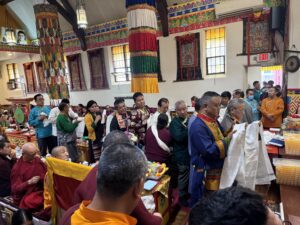
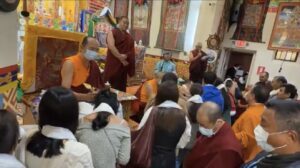
Following the teachings, Rinpoche conferred the Long Life Empowerment (Tsewang) upon the gathered assembly—a sacred ritual meant to invoke the blessings of longevity, spiritual vitality, and inner clarity. As he conducted the empowerment, a silence of profound devotion filled the space. Participants, from young children to elders, received the blessing with heartfelt faith and quiet reverence, grateful for this rare opportunity to connect with a living embodiment of Dharma.
The teachings continued with a luminous exposition of core Buddhist principles, including the Four Noble Truths, the impermanence of all phenomena (Anitya), and the wisdom of emptiness (Shunyata). These concepts, Rinpoche stressed, are not merely for intellectual study but for deep reflection and application in everyday life. Life is transient, like a dewdrop on a blade of grass, and this realization should awaken in us a sense of urgency—not for fear, but for freedom.
Drawing on Bodhisattvacharyāvatāra—the classic text by Arya Shantideva, Rinpoche encouraged practitioners to live not just with learning and ritual, but with courage, patience, and active compassion. A true practitioner, he said, is one who meets challenges with equanimity, responds to suffering with love, and walks the path not for personal gain but for the benefit of all beings.
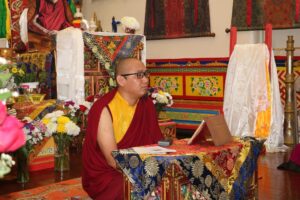
To ensure accessibility for all attendees, Khenpo Ngawang Sangay skillfully translated Rinpoche’s teachings into Nepali, allowing both elders and younger generations to receive the transmission in a language that resonated deeply with their hearts and heritage.
The day’s events left a lasting impression on the community, strengthening spiritual resolve and deepening the collective connection to the Dharma. Before concluding, Rinpoche expressed his heartfelt appreciation to the United Sherpa Association for their leadership in preserving and sharing the spiritual and cultural heritage of the Himalayan region. He noted that such gatherings play a vital role in transmitting the Dharma across time and geography, ensuring its living presence in the lives of future generations.
Who Is His Holiness Sakya Ratna Vajra Rinpoche?
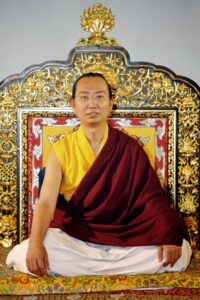
His Holiness Sakya Ratna Vajra Rinpoche, born on November 19, 1974, is the eldest son of His Holiness the 41st Sakya Trizin and was enthroned on March 9, 2017, as the 42nd Sakya Trizin. He is a distinguished lineage holder of the ancient Khön family, renowned for preserving an unbroken succession of accomplished masters. From birth, Ratna Vajra Rinpoche received blessings, empowerments, and teachings primarily from his root guru, His Holiness the 41st Sakya Trizin, along with other eminent masters such as His Holiness the 14th Dalai Lama and the late Chogye Trichen Rinpoche.
His Holiness Ratna Vajra Rinpoche began his formal education in 1980 under the guidance of Ven. Rinchen Sangpo. Early on, he received the precious Lam Dre teachings and undertook rigorous training in Tibetan language, Buddhist philosophy, rituals, and meditation. His academic dedication led him to Sakya College in 1990, where he excelled in Buddhist philosophy and graduated in 1998 with a Kachupa degree, equivalent to a Bachelor’s degree. During his formative years, he also engaged in intensive retreats and received teachings from renowned Sakya scholars, deepening his mastery of both esoteric and exoteric aspects of the Sakya tradition.
Since then, Ratna Vajra Rinpoche has actively shared the Buddha Dharma worldwide. He delivered his first Lam Dre teachings at the Sakya Centre in Rajpur in 2005 and later abroad, including Singapore in 2013. Accompanying his father on international teaching tours and conducting his own, Rinpoche is highly respected for his erudition and clarity in teaching. Known for his gentle demeanor, deep insight, and ability to communicate timeless truths to modern audiences, he travels internationally to offer teachings, empowerments, and spiritual guidance. His presence at the Saka Dawa celebration in the United Sherpa Association Monastery in Queens brought an auspicious and elevated dimension to the program, marking a profound spiritual blessing for the community.
Upholding Faith and Culture Across Continents
The three-day Saka Dawa event served as more than a spiritual gathering, it was a powerful expression of cultural continuity and community resilience. Amidst the diverse and bustling setting of Jackson Heights, the steady rhythm of Om Ma Ni Pad Me Hum reverberated like a sacred thread, connecting the Himalayan diaspora to their ancestral values.
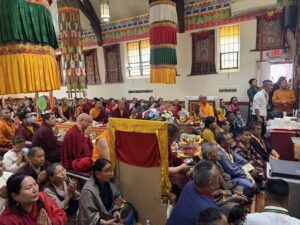
For many, this gathering was a return, not just to their spiritual roots, but to the inner refuge of compassion, wisdom, and interdependence that Buddhism so eloquently teaches.
Ngawang Jimba, the coordinator of the event, shared the deeper purpose behind organizing the three-day program. He explained, “The intention of this gathering is the well-being of all sentient beings and the promotion of world peace. At its heart, the event reflects our organization’s primary goal, to preserve and promote the teachings of the Buddha.”
He emphasized that by reciting mantras, receiving teachings, and coming together in spiritual unity, the community not only strengthens its practice but also radiates compassion and positive energy into the wider world. “Through such events,” he added, “we uphold the timeless values of nonviolence, mindfulness, and altruism, which are essential in today’s world.”
For more photos: Please click here