
Reclaiming Sherpa Historiography

By: Lhakpa Gelu Sherpa
Writing Sherpa History by Sherpas
The historiography of the Sherpa people has, for more than a century, been shaped predominantly by scholars, explorers, missionaries, and mountaineers external to the Sherpa community. Anthropological monographs, colonial era travelogues, mountaineering memoirs, and academic studies produced largely in Europe, North America, and later by non Sherpa Nepali scholars have come to define what is widely accepted as “Sherpa history.” While this extensive body of literature has played a significant role in introducing Sherpa society to global audiences, it has also generated persistent ambiguities, interpretive contradictions, and epistemological limitations. These conditions compel a fundamental historiographical question: who possesses the authority to define Sherpa history, and on what grounds is that authority established?
At the core of this issue lies the imbalance between representation and authorship. Sherpas have been extensively written about, yet comparatively little Sherpa history has been written by Sherpas themselves. As a result, Sherpa society has often been framed through external theoretical paradigms, linguistic translations, and disciplinary assumptions that do not always align with indigenous modes of historical memory, spatial understanding, or moral reasoning. This imbalance has not merely academic consequences; it directly influences contemporary debates on Sherpa identity, indigeneity, territorial belonging, and cultural sovereignty within the Himalayan region and the modern nation state of Nepal.
One of the most contested areas within Sherpa historiography concerns questions of origin and migration. Existing scholarship presents multiple and often contradictory narratives. Some historians and anthropologists propose that Sherpas migrated southward from eastern Tibet, particularly the Kham region, during a broad period spanning the 12th to 16th centuries. This interpretation frequently draws on linguistic affinities, religious lineages, and patterns of trans Himalayan mobility associated with trade, pilgrimage, and monastic expansion. Other scholars suggest alternative timelines within the same medieval to early modern period, emphasizing gradual settlement rather than a single migratory event. Still others challenge the migration paradigm altogether, arguing that Sherpa populations were long established in the Khumbu and adjoining regions, and that later political processes, including the formalization of borders between Nepal and Tibet, retrospectively redefined ancestral territories as sites of migration rather than continuity.
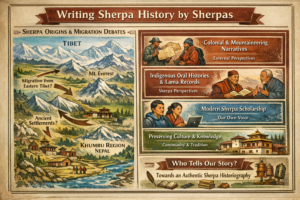
These disagreements are not merely technical disputes within academic literature. They shape how Sherpas are classified within state frameworks, how claims to land and heritage are interpreted, and how Sherpa identity is positioned in relation to broader Himalayan histories. Migration narratives, when uncritically applied, can unintentionally weaken indigenous claims by framing Sherpas as relatively recent arrivals rather than as long standing custodians of specific landscapes. Conversely, oral histories and Lama transmitted narratives emphasize sacred geography, place based memory, and spiritual settlement, challenging linear and externally imposed historical models.
Much of the dominant literature on Sherpa society originates from non Sherpa scholars whose work, while often rigorous and well intentioned, reflects external priorities and disciplinary lenses. Christoph von Fürer Haimendorf’s The Sherpas of Nepal (1964) remains one of the most influential anthropological accounts of Sherpa social organization, kinship, and ritual life. His work provided an early systematic description of Sherpa society and continues to be widely cited. Similarly, Sherry B. Ortner’s High Religion: A Cultural and Political History of Sherpa Buddhism (1989) offers a nuanced and theoretically sophisticated analysis of Sherpa religious life within changing economic and political contexts, particularly the impact of tourism and global capitalism.
At the same time, popular mountaineering narratives such as Maurice Herzog’s Annapurna (1951) and Edmund Hillary’s High Adventure (1955) have powerfully shaped global perceptions of Sherpas. These texts, translated into multiple languages and consumed by mass audiences, often portray Sherpas primarily through the lens of physical endurance, loyalty, and labor within exploration centered frameworks. While they acknowledge Sherpa skill and courage, they rarely engage with Sherpa intellectual traditions, governance systems, or historical self understanding. Over time, such representations have contributed to the reduction of Sherpa civilization to a supporting role within a Euro American narrative of conquest and achievement.
Nepali scholars have provided important corrective perspectives by situating Sherpa society within broader analyses of Himalayan ecology, ethnicity, and political economy. The late Harka Gurung, in works such as Vignettes of Nepal and Nature and Culture: Random Reflections, examined Sherpa adaptation to high altitude environments, patterns of mobility, and the socio economic transformations driven by tourism and state integration. His approach moved beyond romanticized mountaineering accounts and highlighted structural change. Sociologist Chaitanya Mishra further critiqued how ethnic identities in Nepal have been constructed through development discourse, unequal power relations, and external knowledge production. Although these scholars were not Sherpa, their work marked an important shift toward reflexive and critical scholarship within Nepal.
Equally significant, yet frequently marginalized in academic discourse, are historical sources produced by Himalayan Lamas and monastic institutions. Figures such as Lama Sangwa Dorje, remembered in Sherpa oral tradition as a foundational spiritual figure in Khumbu, articulated narratives of settlement that are inseparable from sacred geography, pilgrimage routes, and ritual landscapes. These accounts do not conform to modern historical periodization but instead embed history within moral causality and religious meaning. Trulshik Rinpoche (1923–2011) contributed to the preservation of Sherpa religious and institutional history through monastic records, biographies, and teachings associated with institutions such as Thubten Chöling. Such sources constitute an indigenous historiographical archive that predates and operates independently of modern academic frameworks.
Among Sherpa authored historical works, the contributions of Khenpo Sangay Tenzin Lama Sherpa are of exceptional importance. His widely known work, The History and Generations of the Sherpas, represents one of the most systematic efforts to document Sherpa origins, clan genealogies, settlement narratives, and cultural transmission from within the community. Drawing on oral histories, Lama records, ritual texts, monastery archives, and place based knowledge, Khenpo Sangay Tenzin Lama Sherpa situates Sherpa history within a Tibetan Buddhist moral and cosmological framework. Migration, in his account, is not a purely demographic event but a process intertwined with spiritual purpose, lineage continuity, and ecological belonging.
The marginalization of such indigenous scholarship reveals a deeper structural problem in global knowledge production. When history is written primarily about a community rather than by its members, errors of translation, misinterpretation, and conceptual distortion become normalized. Over time, these errors are reinforced through citation practices, transforming uncertainty into accepted fact. In the Sherpa case, the dominance of mountaineering centered narratives has further obscured Sherpa contributions in governance, trans Himalayan trade, environmental stewardship, artistic production, and philosophical thought.
Contemporary conditions now make a corrective intervention both urgent and achievable. Sherpa scholars today have access to interdisciplinary research tools that were unavailable to earlier generations. Archaeology, historical linguistics, genetics, GIS based spatial analysis, archival research, and systematic oral history methodologies offer new possibilities for reconstructing Sherpa history with greater precision and depth. When these methods are integrated with Lama biographies, clan genealogies, monastic records, and community memory, they can produce a historiography that is both academically rigorous and culturally grounded.
Sherpa institutions and organizations have a decisive role to play in this transformation. Beyond cultural celebration and social advocacy, there is a need to invest in intellectual infrastructure. Scholarship funds dedicated to Sherpa students in history, anthropology, Himalayan studies, archaeology, and related fields are essential. Community supported research centers, digital archives, and oral history initiatives can ensure that indigenous knowledge is preserved, critically examined, and transmitted across generations. Such institutions would allow Sherpa scholars to set research agendas, interpret evidence, and publish findings in both academic forums and community accessible formats.
Ultimately, writing Sherpa history is an act of epistemic self determination. History is not merely a record of the past; it is a framework through which a people understand their identity, assert dignity, and imagine collective futures. As long as Sherpa history remains predominantly authored by others, it will remain fragmented, contested, and incomplete. The transition from being subjects of historical inquiry to becoming its authors, archivists, and theorists is therefore not optional but necessary.
The time has come for Sherpas to write their own history through rigorous, interdisciplinary, and culturally rooted scholarship. Only then can Sherpa historiography speak with authenticity and authority, not as an echo of external interpretation, but as a voice grounded firmly in lived experience, ancestral memory, and intellectual sovereignty.