
Indigenous Wisdom in a Changing Himalaya, Rights, Identity and Responsibility for Our Shared Future
As the world marks the International Day of the World’s Indigenous Peoples on August 9, the occasion carries particular significance for Nepal and the wider Himalayan region. Stretching across some of the world’s most environmentally fragile and culturally diverse landscapes, the Himalayas are not simply mountains, glaciers and rivers. They are living homelands where Indigenous and traditional communities have developed distinctive languages, spiritual traditions, social institutions and systems of ecological knowledge over generations.
The 2026 observance, under the theme “Honouring Indigenous Midwives: Safeguarding Life and Well-being,” calls attention to Indigenous knowledge surrounding birth, health, community and the continuity of life. But the meaning of this day should extend far beyond ceremonial observances. It should compel governments, institutions, Indigenous organizations and wider society to examine whether the world’s Indigenous Peoples are genuinely being included in the political, economic and environmental decisions shaping their future.
The International Day has its roots in the global movement for Indigenous recognition. August 9 commemorates the first meeting of the United Nations Working Group on Indigenous Populations in 1982. In December 1994, the UN General Assembly formally designated August 9 as the International Day of the World’s Indigenous People. Another historic milestone came in 2007 with the adoption of the United Nations Declaration on the Rights of Indigenous Peoples (UNDRIP), establishing an important global framework for collective and individual Indigenous rights.
The word “Indigenous” itself predates these international institutions. Derived through Latin roots associated with being native to or originating in a place, its contemporary meaning goes much deeper than simply describing people who have lived somewhere for a long time. Indigenous identity is connected to historical continuity, collective identity, distinctive cultural and social institutions, ancestral territories and self-identification. There is no single definition capable of capturing the extraordinary diversity of Indigenous Peoples around the world.
Globally, an estimated 476 million Indigenous people live across approximately 90 countries. They represent only around six percent of humanity, yet the World Bank estimates that they account for roughly 18 percent of those living in extreme poverty. This disparity is not simply an economic statistic. It reflects histories of colonization, dispossession, political marginalization, discrimination, geographic isolation, unequal access to education and healthcare, and development models that have frequently extracted resources from Indigenous territories without providing communities with an equitable share of the benefits.
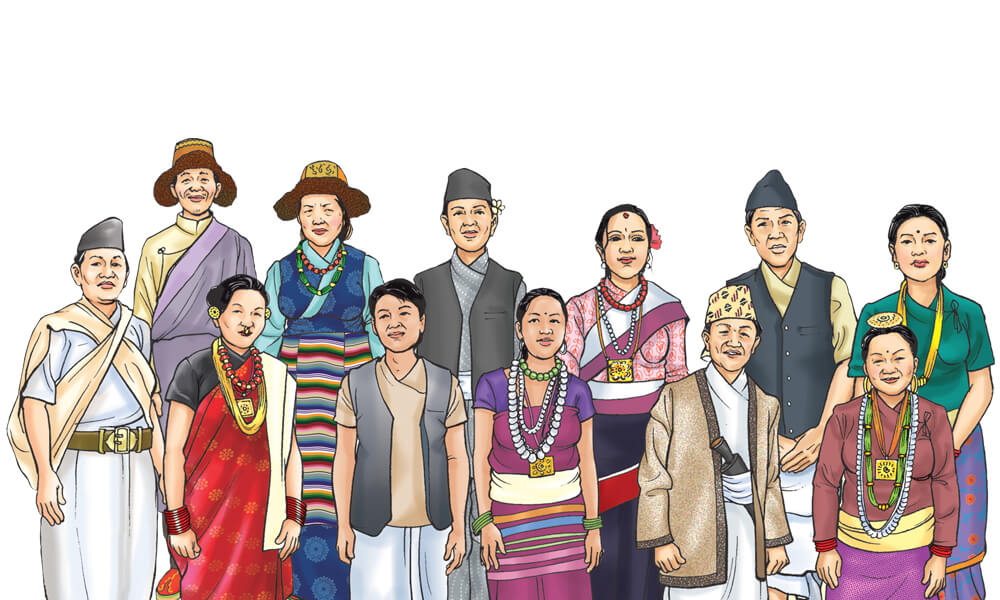
For Nepal, these questions are particularly relevant. The country’s cultural identity has been shaped by numerous Adivasi Janajati communities whose languages, traditions and knowledge systems developed across the Himalayas, hills, valleys and Tarai. Sherpa, Tamang, Gurung, Magar, Rai, Limbu, Thakali, Hyolmo, Newar, Tharu and many other Indigenous nationalities have contributed profoundly to Nepal’s cultural diversity. The broader Himalayan region, including communities across Tibet, Bhutan and the Himalayan areas of India—contains an equally extraordinary range of peoples whose identities are inseparable from their landscapes.
Their cultures are different and should not be reduced to a single “Himalayan Indigenous culture.” Yet many share an important experience: their relationship with land and nature has historically been more than economic.
When mountains are more than resources
For many Himalayan communities, a mountain is not simply a geographical formation to be climbed, mined or commercially developed. A river is more than potential hydropower. A forest is more than timber. A lake or spring is more than a source of water.
These landscapes may also carry spiritual, historical and communal meaning.
Across many Himalayan traditions, sacred mountains, forests, lakes, caves and water sources have been protected through beliefs and customary practices passed down for generations. Concepts surrounding territorial deities, sacred landscapes and water-associated beings created moral restrictions governing how humans interacted with particular places.
From a modern perspective, these traditions are often classified as religion, spirituality or folklore. From another perspective, however, many also functioned as forms of environmental restraint.
When a mountain is sacred, there are limits to exploiting it.
When a forest is spiritually significant, cutting every tree becomes morally unacceptable.
When a spring is sacred, contaminating it becomes not merely environmentally irresponsible but culturally wrong.
The people who developed these traditions did not necessarily use modern terminology such as “biodiversity conservation,” “ecosystem management,” “climate resilience” or “sustainable development.” Nevertheless, many understood a principle that environmental science increasingly emphasizes today: human survival depends upon maintaining healthy relationships with the natural systems around us.
Indigenous knowledge deserves a place beside modern science
Indigenous environmental knowledge should neither be romanticized nor dismissed.
Not every traditional practice is necessarily sustainable, and no community should be frozen into an idealized image of the past. Indigenous societies change like every other society.
But knowledge developed through generations of observation deserves serious consideration.
A Himalayan farmer who recognizes subtle changes in rainfall and planting seasons possesses knowledge. A herder who understands the condition of high-altitude pasture possesses knowledge. An elder who remembers changes in snowfall, springs, vegetation and wildlife across several decades possesses knowledge. Communities familiar with medicinal plants, seasonal migration, water sources and local ecosystems hold information that may not exist in formal scientific records.
Modern science offers satellite imagery, climate modelling, laboratory analysis and systematic measurement. Indigenous knowledge offers generations of highly localized observation and cultural memory.
In an era of accelerating climate change, the Himalayas need both.
Glacial retreat, changing snowfall patterns, extreme rainfall, floods, landslides and shifting water availability are transforming Himalayan environments. Communities living closest to these ecosystems are often among the first to observe these changes, yet they are not always meaningfully represented when policies concerning those landscapes are made.
That contradiction must change.
Development must include the people who live there
No responsible editorial on Indigenous rights should suggest that Himalayan communities should remain isolated from modernization.
Remote communities have the same right as anyone else to quality healthcare, schools, roads, electricity, communications, technology and economic opportunities.
The issue is not development versus tradition.
The real question is: What kind of development, decided by whom, benefiting whom, and at what environmental and cultural cost?
Roads can connect isolated communities, but poorly planned construction can damage water sources and destabilize fragile slopes.
Hydropower can provide clean energy and national revenue, but affected communities deserve meaningful participation in decisions concerning rivers and territories connected with their livelihoods.
Conservation areas can protect biodiversity, but conservation should not transform communities that protected those landscapes for generations into outsiders on their own ancestral lands.
Tourism can provide jobs and opportunities, but it can also turn sacred landscapes and living cultures into commodities.
Development becomes unjust when Indigenous communities bear the costs while benefits flow elsewhere.
This is precisely why ILO Convention No. 169 on Indigenous and Tribal Peoples and UNDRIP are important. Nepal ratified ILO Convention No. 169 in 2007. The Convention emphasizes consultation, participation, cultural integrity and respect for Indigenous institutions and priorities.
A closely related principle in international Indigenous-rights discourse is Free, Prior and Informed Consent (FPIC). At its core lies a simple democratic idea: communities should not learn about decisions affecting their land, resources and future only after those decisions have effectively been made.
Recognition on paper, however, is insufficient. The real test is implementation.
Himalayan tourism presents its own contradiction
The Himalayan tourism economy provides a particularly important example.
Nepal’s international identity is closely associated with its mountains and the Indigenous communities living around them. Everest and the Sherpa people have become globally interconnected in the public imagination. Traditional villages, monasteries, festivals, architecture, food, hospitality and landscapes are central to the experience marketed to visitors from around the world.
Yet we must ask whether local communities receive an equitable share of the value generated from their landscapes and cultures.
The mountain should not become globally wealthy while the people beneath it remain poor.
The culture should not become commercially valuable while the language carrying that culture disappears.
Tourists should not know the name of a mountain better than the history of the people who have lived around it for generations.
Responsible Himalayan tourism must therefore recognize Indigenous communities not simply as workers, guides, cultural performers or attractions, but as rights-holders, knowledge-holders and partners in determining how tourism develops.
The silent disappearance of Indigenous languages
Among the greatest threats facing Indigenous Peoples is one that often occurs quietly: language loss.
International organizations warn that at least 40 percent of the world’s languages are endangered to some degree, with Indigenous languages disproportionately vulnerable. Recognizing the urgency of this crisis, the United Nations designated 2022–2032 as the International Decade of Indigenous Languages.
This should be taken seriously throughout the Himalayas.
Language is not simply a collection of words. Within language live oral history, environmental knowledge, songs, prayers, humor, kinship relationships, place names, medicinal knowledge and ways of interpreting the world.
When a language dies, humanity does not simply lose vocabulary. It can lose an entire library of accumulated experience.
Migration, urbanization, dominant-language education, global media and economic pressures are accelerating language shifts throughout the Himalayan region. Parents understandably want their children to learn national and international languages that provide educational and economic opportunities. But multilingualism should not require the abandonment of the mother tongue.
A child should be able to speak an ancestral language, a national language and English.
Modern education and Indigenous identity should reinforce rather than eliminate one another.
Visibility should not be confused with survival
Indigenous culture is increasingly visible at festivals, public celebrations and on social media. Traditional clothing, dances, foods and ceremonies receive considerable attention.
Visibility is important, but visibility is not necessarily cultural survival.
A community can have increasingly elaborate cultural festivals while fewer children speak its language.
Traditional clothing can become more visible while traditional ecological knowledge disappears.
A dance can survive on stage after its original meaning has been forgotten.
A sacred ceremony can continue as a performance after its deeper philosophy has weakened.
Culture survives not only in public celebrations but through everyday transmission.
It survives when grandparents can speak to grandchildren in their ancestral language. It survives when young people understand the meaning behind rituals. It survives when oral histories are remembered, when traditional place names remain meaningful and when communities continue to understand their relationship with their environment.
The challenge is therefore not simply to display culture but to transmit it.
We must also reconsider what we mean by being “left behind”
Indigenous communities are frequently described as having been “left behind” by development.
There is truth in this when we speak about unequal access to education, healthcare, political representation, infrastructure and economic opportunity. Such inequalities must be addressed.
But the phrase also deserves examination.
Behind according to what standard?
Modern development often measures success through income, consumption, property, urbanization and individual achievement. These measures matter, but they are incomplete.
Traditional Indigenous societies often placed significant value on relationships—with family, community, ancestors, land, animals and future generations.
A healthy forest has value even when it generates no immediate cash income.
A clean river has value.
A language connecting grandparents and grandchildren has value.
A community in which people care for one another has value.
Knowledge accumulated across generations has value.
These forms of wealth rarely appear in GDP calculations.
Indigenous Peoples should have full access to modern opportunities, but modernization should not require them to abandon forms of knowledge and social responsibility that the modern world itself may increasingly need.
Rights must be accompanied by responsibility
Indigenous rights must be defended. Governments have responsibilities to protect equality, dignity, language, cultural heritage, participation and legitimate relationships with traditional lands and resources.
But Indigenous communities and their leaders also carry responsibilities.
If we demand the right to our languages, we must teach those languages to our children.
If we demand protection for our cultures, we must ensure that young generations understand those cultures beyond festivals and costumes.
If we seek protection of ancestral territories, we must resist environmentally destructive practices even when short-term financial incentives make them attractive.
If Indigenous organizations demand transparency and accountability from governments, they must practice those same principles internally.
Rights to land carry responsibilities toward land.
Rights to culture carry responsibilities for transmission.
Rights to self-determination carry responsibilities for inclusive and accountable leadership.
And the rights inherited from our ancestors carry responsibilities toward generations not yet born.
Indigenous youth should inherit both worlds
The future of Himalayan Indigenous cultures rests largely with younger generations.
They should not be forced to choose between ancestral identity and modern opportunity.
A Sherpa child can speak the ancestral language and study artificial intelligence.
A Tamang child can learn traditional songs and become a physician.
A Rai or Limbu child can preserve oral traditions while becoming an engineer or scientist.
A Tharu child can understand ancestral ecological knowledge while participating fully in a modern global economy.
A young Indigenous person can live in Kathmandu, New York, Delhi, London or Sydney without surrendering cultural identity.
Culture does not need to remain unchanged in order to survive. Every living culture evolves.
The goal is not to resist modernity.
The goal should be modernization without cultural erasure, development without dispossession, and participation without disappearance.
A message from the Himalayas
Perhaps the most important contribution Indigenous Himalayan wisdom can make to today’s world is neither a particular ritual nor a particular environmental technique.
It is a way of understanding our place within nature.
Modern civilization has become extraordinarily skilled at asking what we can extract from the Earth.
How much energy can this river generate?
How much timber can this forest produce?
How many tourists can this mountain attract?
How much economic value can this land create?
Indigenous wisdom invites another question:
What do we owe the land that sustains us?
That question has become increasingly urgent.
Climate change, biodiversity loss, pollution and ecological degradation demonstrate that unlimited extraction from a finite planet cannot continue indefinitely.
The Himalayas themselves are warning us.
Glaciers are changing. Weather patterns are shifting. Water systems are under pressure. Mountain communities are experiencing environmental changes directly.
Perhaps some of humanity’s oldest wisdom has become relevant precisely because our newest technologies have given us unprecedented power to transform—and damage—the Earth.
As the world marks the International Day of the World’s Indigenous Peoples, Himalayan News Network believes the occasion must be more than a celebration of identity. It must become a call for dignity, participation, responsibility and intergenerational justice.
Governments must move from symbolic recognition to meaningful implementation of Indigenous rights. Development agencies must listen before designing projects. Researchers should engage respectfully with Indigenous knowledge. Tourism industries must ensure communities are genuine beneficiaries and decision-makers. Indigenous organizations must strengthen accountable leadership. Families must keep languages alive. And younger generations should be empowered to carry ancestral knowledge confidently into the modern world.
Above all, we must stop treating Indigenous wisdom as something belonging only to the past.
The future does not require humanity to abandon science, technology or development. Nor does respecting Indigenous knowledge mean romanticizing every tradition.
It means recognizing that progress without memory can become destruction.
The wisdom carried by Himalayan communities across generations reminds us of a fundamental truth: human beings are not separate from nature. We are part of it.
Our mountains are more than destinations.
Our rivers are more than electricity.
Our forests are more than timber.
Our cultures are more than festivals.
Our languages are more than words.
And development must mean more than economic growth.
The true measure of progress will be whether future generations inherit living mountains, clean rivers, healthy forests, functioning communities, spoken languages and cultures they understand—not merely photographs and stories of what once existed.
On this International Day of the World’s Indigenous Peoples, that should be the message from the Himalayas to the world:
Protecting Indigenous Peoples is not simply about preserving the past. It is about protecting knowledge, dignity, diversity and a relationship with the Earth that may prove essential to our shared future.
Indigenous Wisdom in a Changing Himalaya, Rights, Identity and Responsibility for Our Shared Future
9 hours ago
Broad Peak’s Silent Warning: How Many More Lives Must the Mountains Claim Before We Listen?
1 week ago

Shechen Center New York Opens, Bringing a Living Buddhist Lineage to the Heart of New York City
3 weeks ago