
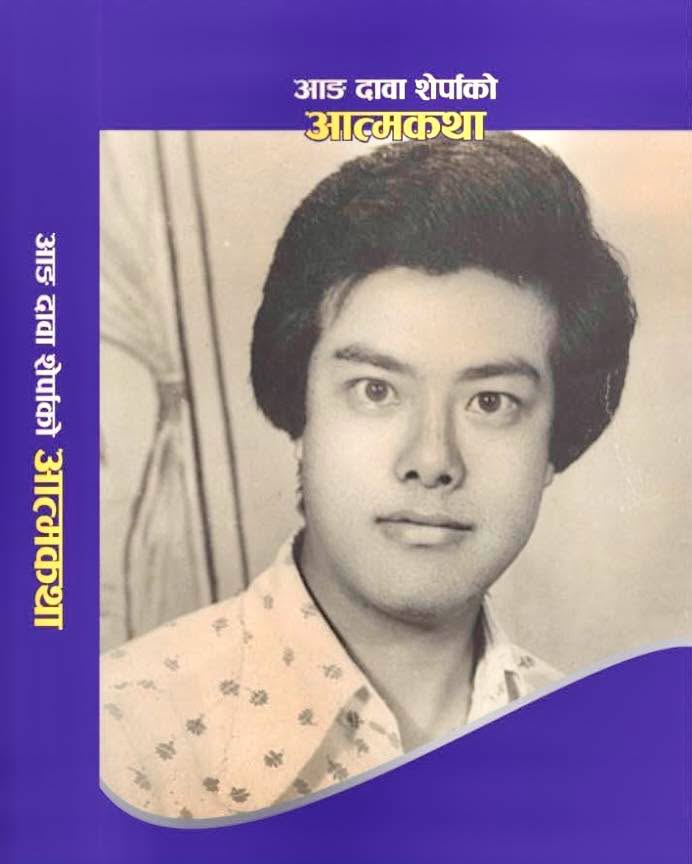
Ang Dawa Sherpa’s Autobiography Launched in New York, Celebrating a Lifetime of Education and Service
NEW YORK, October 4, 2026 — It was the beginning of a beautiful October in New York. Autumn had quietly arrived, the temperature was beginning to fall, and the warmth of summer was gradually giving way to the crispness of the new season. Outside, the city was moving toward fall; inside the main prayer hall of United Sherpa Association (Sherpa Kyidug) in Elmhurst, Queens, however, another kind of warmth filled the air, the warmth of reunion, gratitude, memory and respect.
At the back of the hall stood the magnificent main shrine, surrounded by sacred representations of the Buddha, Avalokiteshvara, Guru Rinpoche, Tara and Manjushri. The Kangyur, containing the translated words of the Buddha, rested within the sacred space. Traditional thangka paintings adorned the walls, while images of great Buddhist masters seemed to look silently over the gathering. Compassion, wisdom, and the aspiration toward enlightenment were reflected in the sacred surroundings, giving the afternoon a meaning that extended far beyond the launch of a book.
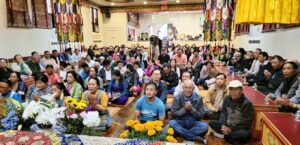
Before that shrine sat hundreds of former students, family members, Buddhist monks, community leaders, friends and well-wishers. Some had once known one another as young students in the mountains of Solukhumbu. Decades later, life had taken them in different directions—from villages in the Himalayas to cities across Nepal, the United States and beyond. Yet on this autumn afternoon they had come together again for one purpose: to honor their former teacher, Ang Dawa Sherpa, and to celebrate the launch of his autobiography. The theme of the occasion, “Education Is the Foundation for the Future,” captured the essence of both the book and the life being celebrated.
The program was organized by former students of Shree Jana Jagriti Secondary School in Salleri, Solukhumbu, particularly alumni now living in New York, New Jersey and Connecticut. Kalsang Chhopel, Palden Sherpa, Lhakpa Pinasa Sherpa and Chhiring Sherpa were among the principal organizers representing the former students’ group. Kalsang Chhopel served as moderator, guiding an afternoon filled with memories, personal reflections, and expressions of gratitude. What began as a formal book-launch ceremony gradually became a reunion between a teacher and generations of students whose lives he had helped shape.
The chief guest, Venerable Lopen Gyurme Chhodrak, formally launched the autobiography in the presence of the assembled guests. Venerable monks and participants also offered prayers for Ang Dawa Sherpa’s speedy recovery and good health. Against the backdrop of the monastery shrine, the prayers added a deeply spiritual dimension to a gathering already rich with emotion and remembrance.
To understand the significance of the occasion, one had to travel back in memory several decades to Solukhumbu. At a time when educational opportunities in Nepal’s remote Himalayan regions were still extremely limited, access to schooling in Solukhumbu was far from easy. Schools were few, transportation was difficult, educational resources were scarce, and many isolated communities had limited access to formal education. It was amid these geographical, social, and educational challenges that Ang Dawa Sherpa devoted an important chapter of his life to bringing the light of education to a new generation.
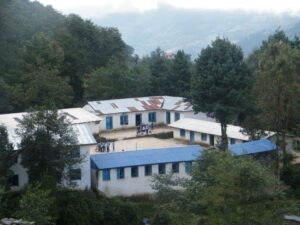
As headmaster of Shree Jana Jagriti Secondary School in Salleri, he did more than administer a school. He became a teacher, guardian, and mentor to generations of students. Young people traveled from villages throughout Solukhumbu and surrounding areas to study at the school, carrying with them the hopes of families who believed education might open a different future for their children. Through discipline, dedication and personal guidance, Ang Dawa Sherpa helped strengthen not only the school’s educational environment but also the belief that education could transform individual lives and, ultimately, an entire community.
For him, education was never simply about textbooks, examinations or certificates. It was also about character, responsibility, discipline, compassion and the ability to see possibilities beyond one’s immediate circumstances. Many of his students eventually left Solukhumbu and entered different walks of life as educators, engineers, doctors, public servants, professionals, entrepreneurs and community leaders. Some remained in Nepal, while others crossed oceans and established new lives abroad. Decades later, many of them returned, not to their old classroom in Salleri, but to a monastery hall in New York, to express gratitude to the teacher who had once encouraged them to move forward.
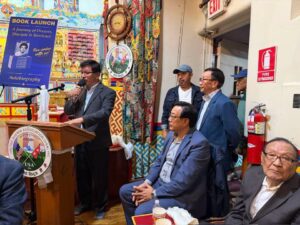
Among the speakers was Ang Phuri Sherpa, one of Ang Dawa Sherpa’s former students, who reflected on his teacher’s contribution to education and social development in Solukhumbu. Ang Phuri Sherpa, who later held a senior position with Nepal’s Agricultural Development Corporation before moving to the United States, recalled the influence Ang Dawa Sherpa had on students growing up at a time when opportunities for education in the Himalayan region were limited. Senior former student Jiku Lama, a former overseer, also spoke about Ang Dawa Sherpa’s contribution and the lasting influence of his educational service. Their reflections carried a common message: a teacher may guide a student for only a few years, but the influence of that guidance can remain for a lifetime.
Engineer Temba Sherpa, president of the United Sherpa Association, described Ang Dawa Sherpa as a mentor and guide. Recalling his own experiences connected with development work in Lumbini, he said Ang Dawa Sherpa had encouraged him and provided guidance during important stages of his professional journey. He also recalled Ang Dawa Sherpa’s contribution to Buddhist institutional development, including his role in facilitating land for the construction of a monastery associated with His Holiness Trulshik Rinpoche in Lumbini, his support in matters related to honorary citizenship for the revered Buddhist master, and his contribution toward the development of a monastery in Halesi.
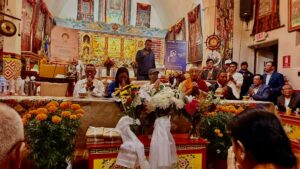
Ang Chhiring Sherpa, chief editor of The Everest Times, presented a broader picture of Ang Dawa Sherpa’s public life, tracing his contribution from Solukhumbu to national institutions. He recalled Sherpa’s involvement in Nepal’s teachers’ movement, including his service as vice-chairman of a teachers’ union, where he worked for the rights, dignity, and professional interests of teachers. He also highlighted Ang Dawa Sherpa’s service as Member-Secretary of the Lumbini Development Trust, describing it as an important chapter in his public life. His work in Lumbini, he noted, contributed to institutional development surrounding the birthplace of the Buddha and to efforts to strengthen Lumbini’s place as an international center of peace, Buddhist heritage and the Buddha’s universal teachings.
Ang Dawa Sherpa’s relationship with the United Sherpa Association in New York was also remembered during the program. Chhongba Lama, Chair of the Board of Trustees of United Sherpa Association, spoke about Sherpa’s longstanding association with the organization as an adviser and trustee. He said Ang Dawa Sherpa had consistently shared his experience, advice, and guidance for the development of the institution. In recognition of his contributions to education, public service and the community, United Sherpa Association presented him with a certificate of appreciation. His former students presented him with a statue of the Buddha, a deeply symbolic gesture of gratitude and respect from students to their teacher.
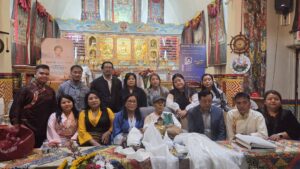
One of the most emotional moments of the afternoon came when Ang Lhemi Sherpa, daughter of Ang Dawa Sherpa, addressed the gathering on behalf of the family. She expressed heartfelt gratitude to the former students who organized the program and thanked the community leaders, participants, relatives, friends, and well-wishers who had come together to honor her father. She reflected that the occasion was not merely a celebration of the publication of a book, but a celebration of his life journey, a journey shaped by education, compassion, responsibility, and service.
At the center of all the tributes was Ang Dawa Sherpa himself. Addressing the gathering, he thanked his former students, family members, organizers, venerable monks, participants, and well-wishers. Looking across a hall filled with people representing different chapters of his life, he reflected on how meaningful it was to see hundreds of people gathered together. He said he had always tried to live his life without knowingly causing harm to others, and the goodwill surrounding him that afternoon gave him a profound sense of fulfillment. Only a fortunate few, he observed, receive the opportunity during their lifetime to witness so many former students, relatives, friends and well-wishers come together to honor their journey, and for that he expressed deep gratitude.
Reflecting on the moral foundation that had guided him throughout his life, Ang Dawa Sherpa spoke about the Panchashila, the Five Precepts, which he said he had sought to follow throughout his journey. He recalled learning those ethical principles first from his father and later through the teachings and influence of Venerable Bhikshu Amritananda, one of Nepal’s influential Buddhist monks. Those teachings, centered on ethical conduct, compassion, restraint and respect for life, became principles he carried into education, public responsibility and community service.
Ang Dawa Sherpa also reflected on his years at the Lumbini Development Trust, saying that the opportunity to serve as Member-Secretary broadened his wisdom and understanding. His time in Lumbini brought him into contact with a wider world of people, cultures, ideas and responsibilities and deepened his understanding of the universal significance of the Buddha’s birthplace. A journey that had begun in the mountains of Solukhumbu had gradually expanded into education, social service, Buddhist heritage and national public responsibility.
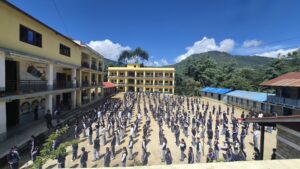
The autobiography will also carry that journey back to where much of his educational legacy began. Proceeds from the sale of the book will be contributed to Shree Jana Jagriti Secondary School in Salleri, Solukhumbu, through the Ang Dawa Sherpa Foundation. The decision gives the autobiography a purpose beyond preserving the past: a book documenting a life shaped by education will help support education for another generation.
There is a beautiful completeness to that circle. Decades ago, Ang Dawa Sherpa devoted his time and energy to educating young people at Jana Jagriti Secondary School. Those students grew up, traveled across Nepal and around the world, and built lives of their own. Years later, they gathered thousands of miles from Salleri to honor their teacher and celebrate the story of his life. Now, through the sale of that story, support will travel back across the ocean and into the mountains, returning to the very school where so many of those relationships first began.
The autobiography launched that afternoon contains the written memories of Ang Dawa Sherpa’s life, but another autobiography, unwritten and perhaps even larger, could be seen throughout the hall. It was written in the lives of his former students. Every student who carried education from a classroom in Salleri into a profession, a family, a community or another part of the world became, in some way, another living page of that story.
That is perhaps why the theme “Education Is the Foundation for the Future” resonated so deeply with the occasion. Buildings grow old, official positions eventually pass to others, and titles fade with time, but knowledge and values passed from one generation to another can continue far beyond a single lifetime. Many decades ago in Solukhumbu, Ang Dawa Sherpa helped light such a lamp. On a cool October afternoon in New York, surrounded by his former students, family members, monks and well-wishers, it was clear that the light was still traveling.
Photo source: United Sherpa Association Inc.