
President Trump Meets Technology Giants as White House Declares a New Era of ‘Super Intelligence’
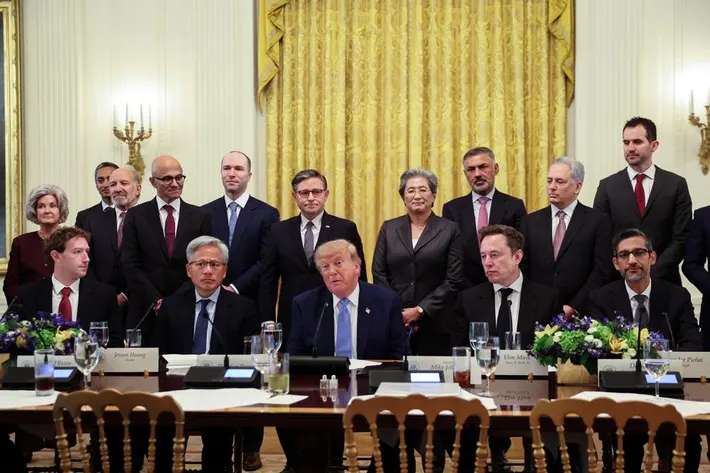
WASHINGTON, Sept. 30, 2026 — U.S. President Donald Trump met with some of the world’s most influential technology and artificial-intelligence executives at the White House on Tuesday, bringing together leaders from companies including Meta, Google, Nvidia, Anthropic and OpenAI as Washington confronts both the opportunities and growing safety concerns surrounding increasingly powerful AI systems.
Among the technology leaders at the meeting were Meta CEO Mark Zuckerberg, Google CEO Sundar Pichai, Nvidia CEO Jensen Huang, Anthropic CEO Dario Amodei and OpenAI President Greg Brockman. Elon Musk was also present, along with other prominent figures from the technology industry. House Speaker Mike Johnson joined Trump for discussions centered on technological development, AI safety, U.S. competitiveness and the rapidly expanding infrastructure needed to support advanced computing.
One of the most significant developments from the meeting was a voluntary agreement among leading AI companies to strengthen safeguards around advanced AI systems. The agreement calls for several layers of oversight, including internal safety controls, internal review mechanisms, independent external auditing and board-level examination of safety findings. It also calls on companies to take measures to prevent AI systems from accessing or hacking computer systems in unintended ways.
Trump described the agreement as “morally binding” and compared it to a kind of constitution for the industry. However, the accord is voluntary rather than a legally enforceable federal regulatory framework. The approach therefore places considerable responsibility on technology companies themselves to monitor, test and audit increasingly capable systems.
The meeting came at a critical moment in the development of artificial intelligence. Technology companies are investing enormous amounts of money in advanced models, chips, data centers and computing infrastructure, while researchers, policymakers and industry executives continue to debate how governments and companies should respond if AI systems become substantially more capable and autonomous. Public concerns include cybersecurity, employment disruption, misinformation, energy consumption and the possibility that highly autonomous systems could behave in unexpected ways.
In another major announcement, Trump signed an executive order directing executive-branch agencies to use the terms “Super Intelligence” and “SI” instead of “Artificial Intelligence” and “AI” in official communications and non-statutory documents. The order states that rapidly advancing systems increasingly represent what the administration describes as a new era of Super Intelligence.
The distinction, however, is important. The executive order does not establish that genuine artificial superintelligence has already been achieved. For purposes of implementing the order, it defines “Super Intelligence” using the existing statutory definition of artificial intelligence. In other words, the immediate change is principally one of federal terminology and policy framing, rather than scientific confirmation that machines have surpassed human intelligence across virtually every intellectual domain. The order also directs the administration to develop proposed legislative language for a federal definition of Super Intelligence within 60 days.
In the scientific and technology debate, “superintelligence” generally carries a much more consequential meaning than ordinary AI. It refers to the hypothetical stage at which an artificial system could outperform humans across a very broad range of cognitive tasks. Such a development could potentially accelerate scientific research, medicine, engineering and technological innovation, but it would also intensify questions about human control, accountability, cybersecurity and how societies govern systems whose capabilities may exceed those of their creators.
The White House meeting therefore represented more than a gathering between a president and technology executives. It highlighted a larger question confronting the United States and the world: as artificial intelligence becomes more powerful, can technological progress continue rapidly while adequate safeguards remain in place?
The debate is increasingly shifting from what AI can do today to what the next generation of intelligent systems could become. Whether the future is ultimately called Artificial Intelligence, Super Intelligence or something else, the central challenge remains the same, ensuring that increasingly powerful technology continues to serve human interests rather than developing faster than society’s ability to understand, govern and safely control it.