
Nepal’s Bhotekoshi Catastrophe: Death Toll Reaches 157 as Hundreds Remain Missing
Kathmandu, August 26, 2026 — Nepal is confronting one of its deadliest Himalayan flood disasters in recent years after a massive avalanche of ice, rock and debris triggered a destructive flash flood through the Bhotekoshi and Trishuli river systems, killing at least 157 people and leaving hundreds more missing.
According to the latest update reported by Reuters late Wednesday, Nepal Police said 157 bodies had been recovered. More than 400 tourists were reported missing, including about 340 foreign nationals. The number of deaths is expected to rise as search teams continue working through devastated settlements, submerged buildings, riverbanks and vast fields of mud and debris.
Earlier figures had placed the death toll at 22 and later 95, illustrating how rapidly the scale of the disaster became apparent as bodies were recovered farther downstream. By late Wednesday, the police figure had climbed to 157.
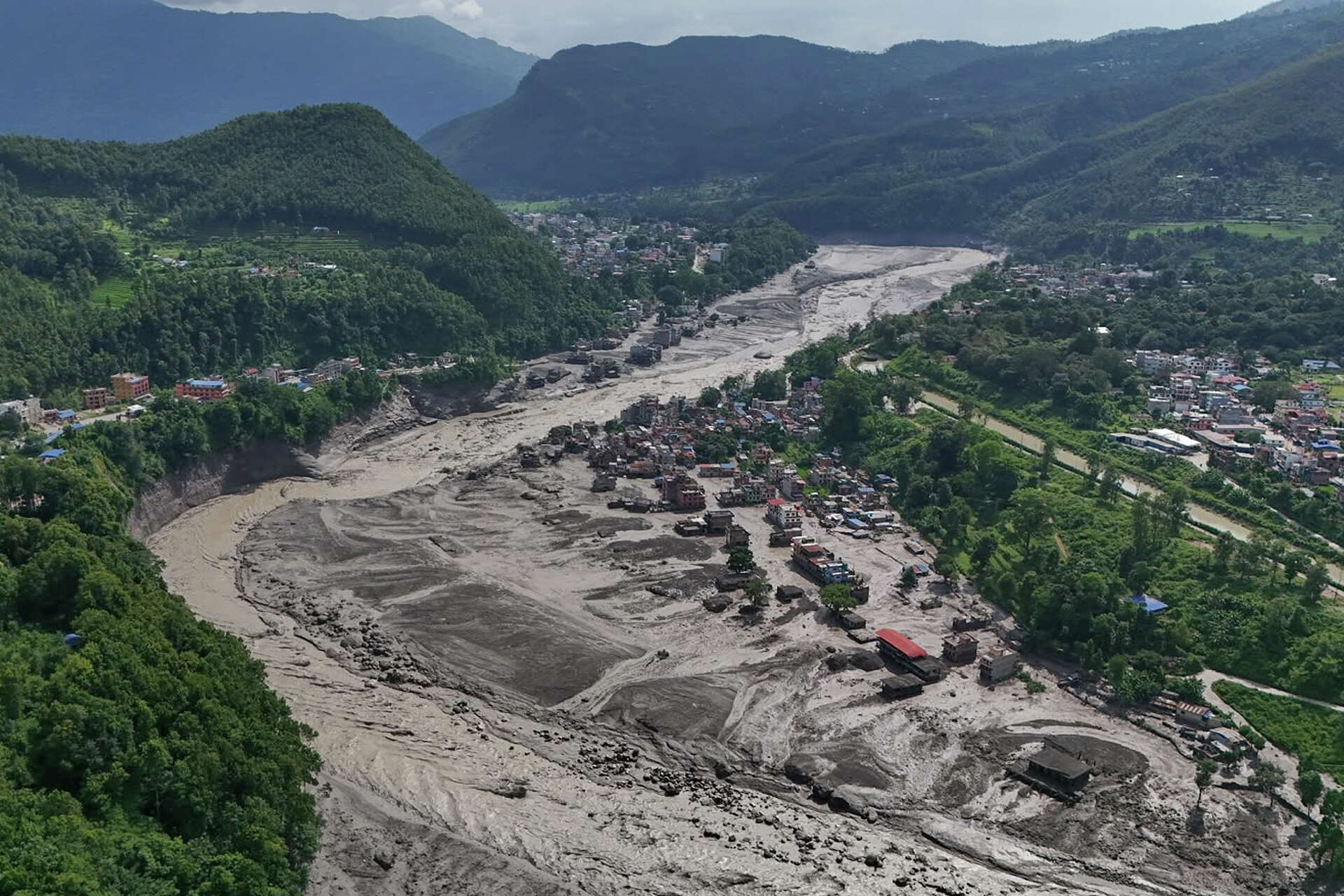
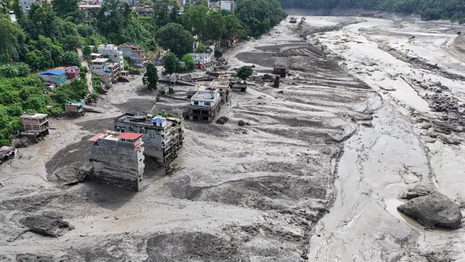
The disaster struck on Wednesday morning when an enormous surge of water, mud, rocks and glacial debris descended from the Himalayan border region and entered the Bhotekoshi river system. The hardest-hit areas include Timure and Syaphrubesi in Rasuwa district, while the flood continued downstream through Nuwakot, Dhading and toward the Trishuli and Narayani river systems. Homes, roads, bridges, vehicles and hydropower infrastructure were swept away.
Hundreds Still Missing
The number of people unaccounted for makes the disaster particularly alarming.
Nepali authorities reported 403 people missing, including 341 foreign nationals, according to international reports citing Nepalese officials. Among those reported missing were approximately 133 Indian pilgrims, 47 Americans, 34 Australians, 33 British citizens and 24 Canadians. Many were travelling through the region toward Kailash Manasarovar in Tibet, one of the most important pilgrimage destinations for Hindus and Buddhists.
Nepali citizens, tourism workers, drivers, guides, local residents and members of the security forces are also among those who have been reported missing.
The casualty picture remains fluid. Some people initially listed as missing could ultimately be found alive or may have lost communication because roads, electricity and mobile networks were destroyed. At the same time, rescuers fear that more bodies may be discovered as access improves.
Across the border in Tibet, Chinese state media reported at least three people dead and 265 missing in Gyirong County. Those figures are separate from Nepal’s reported casualties.
Thus, based on the latest reliable figures available Wednesday evening, Nepal alone has reported 157 bodies recovered, while more than 400 people remain missing. The broader Nepal-Tibet disaster has caused additional deaths and disappearances on the Chinese side.
What Caused Such a Massive Flood?
Perhaps the most important question is what caused such an enormous flood when there was no corresponding extreme rainfall in the affected Nepalese area.
Initial scientific analysis increasingly points toward an extraordinary high-altitude ice-rock avalanche rather than an ordinary monsoon flood.
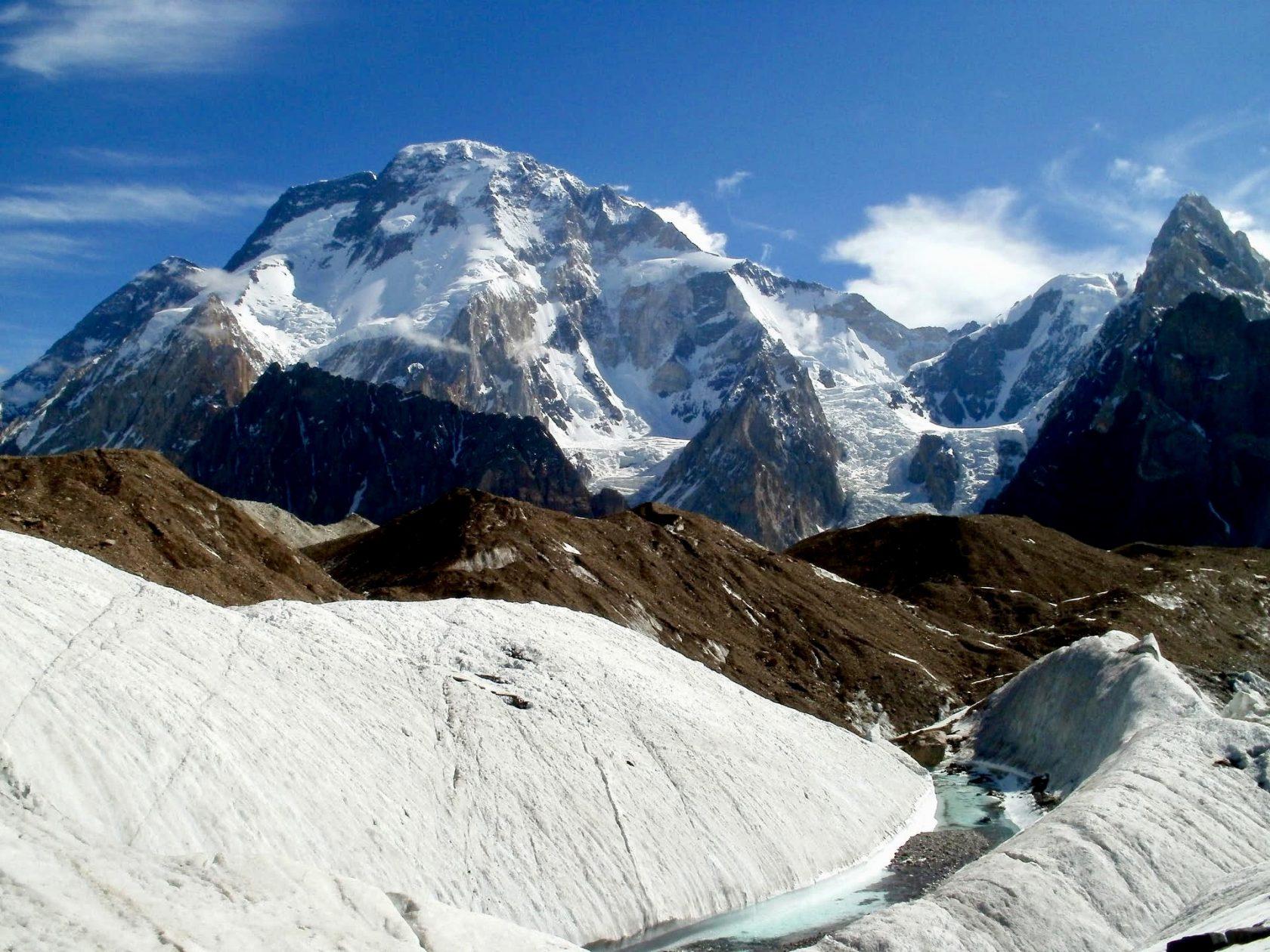
Satellite imagery reviewed by scientists indicates that a substantial portion of the lower end of a glacier broke away at an altitude of approximately 5,200 metres. It then plunged around 1,200 metres onto the valley floor below, carrying ice, rock and sediment with tremendous force.
Nepal’s National Disaster Risk Reduction and Management Authority said preliminary satellite analysis indicated that a landslide involving ice and rock occurred in the Lhende River area, approximately 20 kilometres northeast of the Rasuwagadhi Nepal-China border crossing. The resulting mass entered the river system and generated a debris-laden flood.
Geologist Prakash Pokharel of the disaster authority described the event as an “ice-rock avalanche.”
This distinction is critical. It means that what devastated the valleys below may have been less like an ordinary flood and more like a rapidly moving mixture of water, boulders, ice, soil and sediment.
Such a dense flow can behave almost like liquid concrete, giving structures and people in its path very little chance of survival.
Was an Earthquake Responsible?
Early reports suggested that a magnitude 4.4 earthquake may have triggered the avalanche.
However, that explanation has become less certain.
The German Research Centre for Geosciences detected a seismic event shortly before the disaster. But the U.S. Geological Survey subsequently concluded that the recorded seismic energy appeared to have been produced by the glacier and debris collapse itself rather than necessarily by a conventional tectonic earthquake.
Scientists therefore remain cautious about claiming that an earthquake caused the disaster.
The sequence may instead have been reversed: the enormous collapse of ice and rock itself could have generated vibrations strong enough to register on seismic instruments.
Determining the exact trigger will require detailed examination of satellite imagery, geological evidence, weather data and conditions within the glacier before the collapse.
Did Global Warming Play a Role?
The immediate trigger and the underlying environmental conditions must also be distinguished.
Scientists have not yet concluded that climate change directly caused Wednesday’s avalanche. Such a conclusion would require further investigation.
However, there are important reasons why climate change must form part of the analysis.
Satellite observations examined by earth scientists showed substantial snow loss around glaciers in the area during the approximately 24 hours preceding the disaster. University of Calgary earth scientist Dan Shugar told Reuters that some glaciers that had been snow-covered appeared largely as exposed ice shortly afterward, suggesting unusually warm conditions may have prevailed.
This matters because Himalayan glaciers are already undergoing rapid transformation.
According to figures cited by Reuters from United Nations assessments, Nepal’s snow-covered mountains have lost close to one-third of their ice in slightly more than three decades because of global warming. Glacier melting in Nepal accelerated dramatically during the most recent decade, with melting occurring about 65 percent faster than during the previous decade.
As glaciers shrink, mountain landscapes do not simply lose ice.
They can become physically unstable.
Melting ice may expose fractured rock. Frozen material that once helped bind mountain slopes together can weaken. Glacial lakes can expand. Ice cliffs can collapse. Avalanches can enter rivers or lakes, and enormous quantities of sediment may suddenly move downhill.
The result can be cascading disasters: glacier collapse, avalanche, temporary river blockage, sudden dam failure and finally a devastating flash flood.
That appears to be one of the mechanisms investigators are considering in Rasuwa.
Nine-Metre Rise in Just Half an Hour
The speed of Wednesday’s flood illustrates why Himalayan flash floods are so dangerous.
ICIMOD reported that water levels at Galchhi downstream reportedly rose by as much as nine metres within approximately 30 minutes as the surge travelled through the Bhote Koshi and Trishuli systems.
Nine metres is roughly the height of a three-storey building.
For communities along a narrow Himalayan river valley, a rise of that magnitude within half an hour leaves almost no margin for conventional evacuation.
People may hear a roar upstream or see water changing colour, but by then the destructive front may already be only minutes away.
This is precisely why early-warning systems must begin far upstream rather than relying only on gauges near inhabited settlements.
Settlements Swept Away
Witness accounts describe extraordinary devastation.
Homes near riverbanks were buried or washed away. Vehicles disappeared into the torrent. Roads were severed. Bridges collapsed. Power projects were damaged, communications failed and large areas were left without electricity.
A health worker in Rasuwa told Reuters that settlements beside the river had been completely swept away and that five members of his own family were missing.
The flood also damaged police installations in Timure, Syaphrubesi and Rasuwagadhi, demonstrating that even government facilities expected to respond to disasters were themselves vulnerable.
Helicopter operations were initially difficult because aircraft could not safely land in some of the worst-hit areas while rivers continued flowing outside their normal channels.
Nepal Army, Nepal Police and Armed Police Force personnel have been deployed for search and rescue, while helicopters have transported survivors and emergency supplies.
Why Were So Many Tourists in the Area?
The disaster occurred along an important international tourism and pilgrimage corridor.
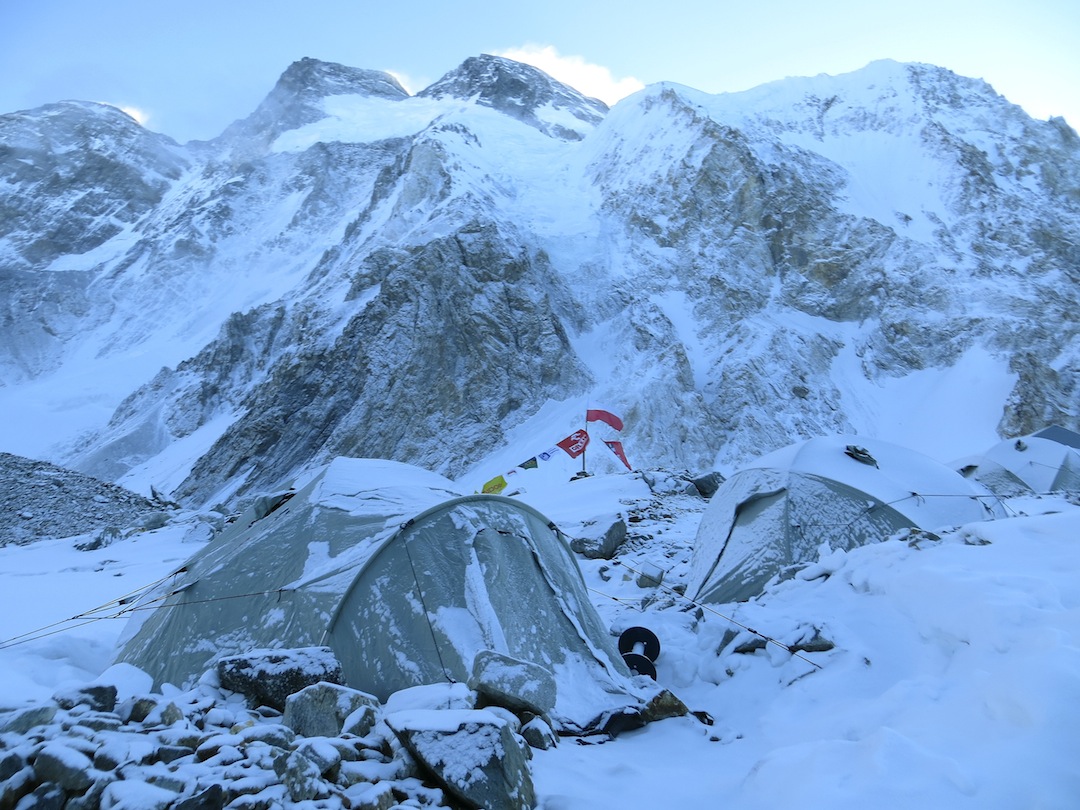
The Rasuwagadhi-Gyirong route connects Nepal with Tibet and is used by travellers heading toward Kailash Manasarovar. August is also an active period for religious travel in the Himalaya.
Consequently, large numbers of travellers were concentrated along a narrow mountain corridor precisely when the disaster occurred.
Among the hundreds reported missing are pilgrims from India and other countries, tourists, trekkers, guides and tourism workers.
The tragedy therefore has an international dimension. Governments including the United States, India, Australia, Britain and Canada have been seeking information about their citizens.
The United Nations has said teams and partner organisations are mobilising personnel and relief supplies to support Nepal.
This Is Not Rasuwa’s First Warning
Perhaps one of the most troubling aspects of the disaster is that the same region experienced a major flood only last year.
On July 8, 2025, another sudden flood struck the Bhotekoshi system near Rasuwagadhi. Nepal’s Department of Hydrology and Meteorology later concluded that the event originated from a glacial lake outburst involving the Lhende River near the Nepal-China border.
Now, barely more than a year later, another catastrophic event has struck the same Himalayan corridor.
The exact mechanisms of the two disasters may differ, but together they point toward a larger problem: Nepal’s high mountain environment is becoming increasingly hazardous.
ICIMOD has warned that floods, landslides, avalanches and droughts are becoming more severe across the Hindu Kush Himalaya as rapid changes occur in the region’s water, land and atmosphere.
Nepal Cannot Treat This as an Ordinary Natural Disaster
Nepal cannot prevent every avalanche or glacier collapse.
But deaths on this scale should force the country to examine what can be prevented.
Which glaciers and unstable mountain slopes are being continuously monitored?
Where are the automatic water-level sensors?
Can Nepal receive real-time satellite and river information from the Tibetan side of the border?
How quickly can an unusual river blockage be detected?
How many communities have functioning sirens?
Can authorities send emergency alerts simultaneously to every mobile phone inside an endangered river valley?
Are hotels and tourism operators in high-risk corridors required to maintain evacuation plans?
Are roads, bridges and hydropower projects being designed using climate projections rather than historical river levels?
These questions are no longer theoretical.
They are questions of life and death.
Climate Justice for the Himalaya
Nepal must strengthen its own planning, but the country also occupies an unfair position in the global climate crisis.
Nepal contributes only a very small fraction of global greenhouse-gas emissions, yet it contains some of the world’s most climate-sensitive mountains.
The greenhouse gases accumulated through decades of industrial development largely originated elsewhere, while Himalayan countries now face retreating glaciers, unstable slopes, glacial-lake hazards, floods and changing water systems.
For Nepal, climate finance should therefore not simply mean international meetings, reports and promises.
It should finance glacier-monitoring satellites, weather stations, automatic river sensors, emergency communication systems, resilient bridges, scientifically planned settlements and trained disaster-response teams.
Loss-and-damage funding should reach communities living beneath unstable glaciers and beside dangerous rivers.
Nature Cannot Be Defeated, but Disaster Can Be Reduced
Humankind cannot command a Himalayan glacier not to collapse.
But a natural hazard does not automatically have to become a mass-casualty disaster.
The difference lies in knowledge, preparation, early warning, responsible development and political commitment.
The Bhotekoshi catastrophe has now taken at least 157 lives in Nepal, while hundreds remain missing. The numbers may unfortunately rise further as search teams move through mud, collapsed structures and isolated valleys.
Behind every number is a family waiting for a telephone call, a parent searching for a child, a husband or wife waiting beside a rescue centre, or relatives hoping that someone listed as missing will still walk home alive.
But this tragedy must eventually lead to something beyond mourning.
The Himalaya is changing.
Glaciers are retreating. Ice and rock slopes are becoming unstable. Glacial lakes are changing. Extreme rainfall is intensifying in many locations. Roads and settlements continue expanding into fragile valleys.
The lesson from Rasuwa is therefore not simply that nature is powerful.
It is that Nepal must prepare for a Himalayan climate in which yesterday’s definition of a “rare disaster” may no longer be sufficient for tomorrow.