
The Climate Crisis in the Himalayas: Why Nepal Needs Climate Justice, Not Charity
The Himalayas have long been called the roof of the world. Their glaciers, snowfields, rivers, forests and fragile ecosystems sustain communities far beyond the people who live among them. The Hindu Kush Himalayan region contains the largest concentration of snow and ice outside the polar regions and forms the headwaters of some of Asia’s great river systems. What happens in these mountains therefore matters not only to Nepal but to hundreds of millions of people across Asia.
Today, however, the Himalayas are becoming one of the clearest warning signals of a rapidly warming planet. Glaciers are retreating, snow and ice conditions are changing, permafrost is degrading, glacial lakes are evolving, and changing rainfall is interacting with some of the steepest and most geologically fragile terrain on Earth. For Nepal, climate change is no longer simply an environmental issue. It is becoming an economic crisis, a humanitarian challenge, a threat to infrastructure and development, a danger to cultural heritage and, increasingly, a question of justice.
The fundamental question is straightforward: Why should a country that has contributed so little to the global climate crisis be expected to bear such enormous consequences largely on its own?
How Global Carbon Emissions Reach the Himalayas
To understand why Nepal’s case is fundamentally about climate justice, we first need to understand the scientific connection between carbon emissions produced around the world and environmental changes occurring high in Nepal’s mountains.
When coal, oil and natural gas are burned for electricity, industry, transportation and other purposes, carbon dioxide and other greenhouse gases are released into the atmosphere. Carbon dioxide does not simply disappear after leaving a smokestack, vehicle or aircraft. A significant portion remains in the atmosphere for very long periods, strengthening the greenhouse effect and increasing the amount of heat retained within Earth’s climate system.
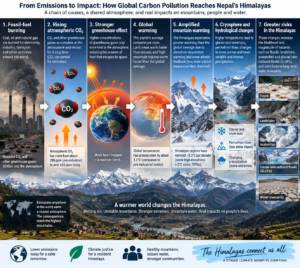
The physical connection can be summarized as:
Fossil-fuel burning → rising atmospheric CO₂ → stronger greenhouse effect → global warming → warming of high mountain environments → glacier and snow loss, permafrost degradation and changing precipitation → increasing and changing risks from floods, landslides, avalanches, glacial-lake outburst floods and water insecurity.
This does not mean that carbon dioxide directly “causes” every flood or landslide. The science is more complex. Mountain disasters can involve intense rainfall, geology, glaciers, avalanches, rockfalls, earthquakes, river dynamics, land use, infrastructure and settlement patterns. Climate change instead alters the environmental conditions in which many of these hazards occur.
The Himalayas are especially sensitive to warming. Snow and ice normally reflect a significant amount of incoming solar radiation. As temperatures rise and snow and ice retreat, darker rock and land surfaces become exposed. These surfaces absorb more solar energy, contributing to additional local warming. Scientists refer to this as the snow-albedo feedback.
Black carbon can add another source of warming. Dark particles produced by incomplete combustion can travel through the atmosphere and settle on Himalayan snow and ice. By darkening the surface, these particles reduce reflectivity and increase absorption of solar energy, accelerating melting.
The scientific evidence of Himalayan change is increasingly difficult to ignore. ICIMOD’s major assessment of the Hindu Kush Himalaya found that glaciers disappeared 65 percent faster during 2011–2020 than during the preceding decade. Under high-emissions scenarios, the region could lose a very large proportion of its current glacier volume by the end of this century.
This is not merely about losing beautiful glaciers. The consequences travel through the entire mountain system.
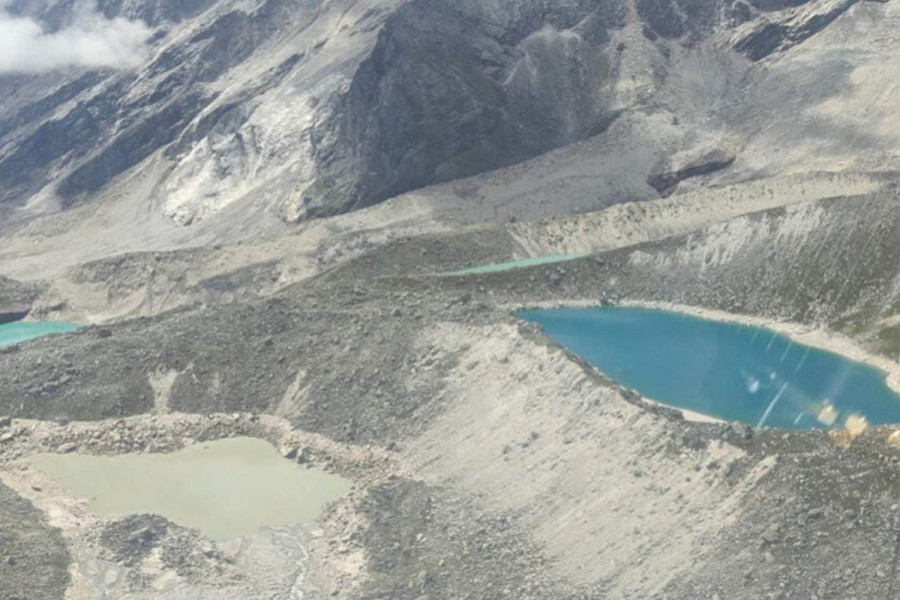
As glaciers retreat, lakes can form or expand. Frozen ground can thaw. Ice and rock slopes can become less stable. Avalanches and landslides can strike glaciers or lakes. Natural dams can form and suddenly fail. In steep Himalayan valleys, one event can trigger another, producing cascading disasters downstream.
Climate change also affects rainfall. A warmer atmosphere can hold more water vapor, creating the physical potential for heavier precipitation when storm conditions occur. In Nepal’s steep terrain, extreme rainfall can rapidly raise rivers, saturate slopes, trigger landslides and transport enormous quantities of sediment and debris downstream.
This relationship has already been quantified in Nepal. Scientists examining the catastrophic rainfall of September 2024 concluded that human-induced climate change made the extreme three-day rainfall approximately 10 percent more intense and around 70 percent more likely in their climate-model analysis. Researchers also emphasized that rapid urbanization and development in flood-prone areas magnified the consequences.
That is an important lesson: climate change may increase a hazard, while poor planning can increase the disaster.
Thame and Rasuwa–Bhotekoshi: Warnings From a Changing Mountain System
The destruction of Thame in the Everest region in August 2024 showed how rapidly a high-altitude event can become a human catastrophe. A sudden flood associated with glacial lakes above the historic Sherpa settlement swept through the village, destroying homes and infrastructure and forcing residents from their community.
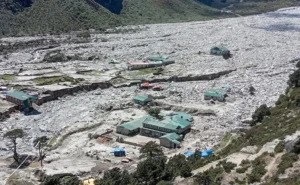
Thame is more than a disaster statistic. It represents the vulnerability of communities that have lived in Himalayan environments for generations. When a mountain village is damaged or displaced, the loss cannot always be measured by counting destroyed buildings. An ancestral landscape contains history, identity, memory, religion, culture and a relationship between people and place that cannot simply be reconstructed somewhere else.
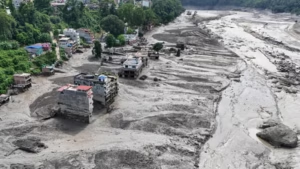
Then came the catastrophic Rasuwa–Bhotekoshi flood of August 26, 2026. Scientific assessments indicate that a massive rock-and-ice collapse high in the mountain system generated a cascading sequence involving ice, rock, sediment and water. The resulting flood moved through the Bhotekoshi–Trishuli corridor with devastating force, damaging settlements, roads, bridges, hydropower facilities and other critical infrastructure.
Scientists must continue investigating precisely how much long-term warming contributed to the conditions behind this particular event. It would be scientifically irresponsible to declare that climate change alone caused the Rasuwa disaster. But it would be equally irresponsible to ignore the broader context: glaciers are retreating, permafrost is warming, high-mountain terrain is changing, and scientists increasingly warn that combinations of ice, rock, water and extreme weather can produce cascading hazards in a warming Himalaya.
Thame was a warning. Rasuwa–Bhotekoshi is another. They are different disasters with different physical mechanisms, but both demonstrate the extraordinary vulnerability of communities living beneath rapidly changing mountain environments.
Who Produces the World’s Carbon, and Who Bears the Consequences?
The question of justice becomes clearer when Nepal’s contribution to global emissions is compared with that of the world’s largest emitters.
Global fossil-fuel carbon dioxide emissions are now measured in tens of billions of tonnes every year. China currently produces roughly 32 percent of global fossil CO₂ emissions, the United States approximately 13 percent, India around 8 percent, the European Union roughly 6–7 percent, Russia around 5 percent, and Japan around 2 percent.
Nepal’s contribution, by contrast, is only a tiny fraction of one percent.
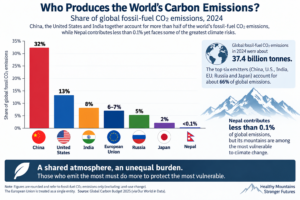
These figures should be interpreted carefully. They refer primarily to fossil-fuel CO₂ and do not capture every greenhouse gas, emissions from land-use change or the carbon embedded in internationally traded products. Nevertheless, the imbalance is unmistakable.
Carbon dioxide also does not recognize political borders. A tonne of CO₂ emitted from a coal-fired power plant, industrial complex, vehicle or aircraft enters a shared atmosphere. It does not remain above the country where it was released. Greenhouse gases accumulate globally, increase temperatures globally and ultimately influence climate systems far from their original source.
The smoke may rise thousands of kilometres away, but the consequences can eventually reach a village beneath a Himalayan glacier.
Today’s emissions, however, are only part of the climate-justice equation. Historical emissions matter because carbon dioxide accumulates in the climate system over long periods. The United States and European industrial economies produced enormous quantities of CO₂ during generations of industrialization and consequently bear particularly significant historical responsibility.
China’s situation is different. Its historical contribution over the entire industrial era is lower than that of the United States, but it is now by far the world’s largest annual emitter. India requires still greater nuance. India remains a developing country with a huge population, and its historical and per-capita emissions are substantially different from those of wealthy industrialized countries. Nevertheless, India is now the world’s third-largest annual emitter, meaning its future energy choices will significantly affect the global climate.
Climate justice should therefore not be reduced to blaming individual countries or populations. Responsibility should be evaluated through several dimensions: historical emissions, current emissions, per-capita emissions, economic capacity and vulnerability.
Whatever measure is used, however, Nepal remains near the opposite end of the equation: very low responsibility and exceptionally high vulnerability.
A farmer in Rasuwa did not create the Industrial Revolution. A Sherpa family living beneath a glacier did not build the world’s fossil-fuel economy. A child living beside the Bhotekoshi did not determine the energy policies of China, the United States, India or Europe.
Yet these communities can lose homes, farmland, schools, bridges, roads, livelihoods, cultural heritage and family members as the climate around them changes.
That is the fundamental injustice at the heart of the Himalayan climate crisis.
Nepal Needs Climate Justice, Not Dependence on Charity
Whenever disaster strikes Nepal, humanitarian organizations, diaspora communities, foreign governments, nonprofit organizations and ordinary individuals respond generously. Food, medicine, temporary shelter and financial assistance arrive. Rescue workers and volunteers put themselves at risk to help affected communities. Such compassion is essential and should always be valued.
There is nothing wrong with charity. During an emergency, humanitarian assistance can mean the difference between hunger and food, exposure and shelter, or life and death.
But charity cannot become the world’s permanent response to climate vulnerability.
Charity asks: How can we help after the disaster? Climate justice asks: Why are vulnerable communities repeatedly paying for a global crisis they contributed so little to creating, and who has a responsibility to help prevent the next catastrophe?
A donation can provide blankets after a flood, but who finances glacier monitoring and early-warning systems? Who pays for climate-resilient bridges and roads? Who supports weather stations, satellite observations and scientific research? Who helps farmers adapt to changing rainfall and water availability? Who finances safer settlements? And who assists communities when relocation becomes unavoidable?
More difficult still, how should the world respond when something cannot be rebuilt?
A road has a construction cost. A bridge has a replacement value. A damaged hydropower facility can be assigned an economic loss.
But what is the financial value of ancestral land?
How do we calculate the loss of a village where generations of families have lived? What price can be placed on sacred landscapes, traditional knowledge, biodiversity, community identity or cultural heritage? How do we measure the psychological impact on children and families repeatedly displaced by disasters?
These are non-economic losses, and they are especially important in Himalayan societies where culture, spirituality, livelihood and landscape are deeply interconnected.
Climate justice recognizes that not everything lost to a changing climate can be replaced with money.
Climate Finance Is Responsibility, Not Generosity
International climate finance for vulnerable countries should therefore not be described simply as wealthy nations giving charity to poorer countries.
Adaptation finance helps communities prepare for consequences they contributed relatively little to creating. It can support stronger bridges, early-warning systems, glacier monitoring, climate-resilient agriculture, safer water systems, watershed protection, emergency preparedness and community resilience.
Loss-and-damage financing addresses an even more difficult reality: some climate-related consequences can no longer be prevented or fully adapted to.
A bridge can be rebuilt. A road can be reconstructed.
But a human life cannot be replaced.
A glacier cannot be rebuilt.
An ancestral landscape cannot simply be recreated somewhere else.
This is why international mechanisms for addressing loss and damage are particularly important for countries such as Nepal. Climate finance should reach vulnerable communities before catastrophe through prevention and adaptation and after unavoidable catastrophe through effective recovery and loss-and-damage mechanisms.
The distinction is fundamental: charity responds to suffering; climate justice addresses responsibility.
China, India and the Need for Himalayan Cooperation
Nepal’s geography adds another dimension to the climate crisis. It lies between China and India, two of the world’s largest present-day carbon emitters, within a Himalayan system in which glaciers, rivers, monsoon patterns, ecosystems and natural hazards cross political borders.
China is upstream of important transboundary Himalayan watersheds. Information about glaciers, glacial lakes, precipitation, river levels and emerging hazards on the Tibetan Plateau can be crucial for communities downstream in Nepal.
India is Nepal’s immediate downstream neighbor. Changes in Himalayan snow, glaciers, rainfall and river systems can eventually affect water availability, agriculture, hydropower, ecosystems and disaster risks throughout northern India and beyond.
Protecting Nepal’s Himalayas should therefore not be viewed by China or India merely as foreign assistance. It is also an investment in their own long-term environmental and economic security.
Nepal, China and India should develop stronger cooperation in satellite monitoring, weather forecasting, glacier and glacial-lake research, hydrological information, emergency communication and transboundary early-warning systems. Scientific information that can save lives should be shared rapidly and transparently.
The reason is simple.
A glacier does not carry a passport. A river does not stop at a border checkpoint. A flood does not wait for diplomatic permission before moving downstream.
Regional cooperation should therefore become a central pillar of Himalayan climate security.
Nepal Must Also Look Inward
Climate justice does not mean Nepal can blame every disaster on foreign countries or global emissions.
Nepal has responsibilities of its own.
Poorly planned roads, river encroachment, deforestation, uncontrolled construction, weak environmental enforcement, vulnerable hydropower development and settlements in high-risk locations can greatly magnify natural hazards. Climate change can increase the danger, while poor governance can turn danger into catastrophe.
Nepal must therefore strengthen land-use planning, environmental assessment, watershed protection, building and infrastructure standards, scientific monitoring and disaster preparedness. Roads, bridges, hydropower facilities, schools, hospitals and settlements in fragile mountain corridors must increasingly be designed for the climate conditions expected in the future—not simply according to historical weather and river records.
Nepal’s hydropower ambitions make this particularly important. Hydropower can provide renewable electricity, support economic development and reduce dependence on fossil fuels. But renewable energy cannot automatically be considered sustainable if projects are constructed without adequately considering geological, hydrological and future climate risks.
Climate resilience must become part of development itself.
Transparency is equally important. If Nepal asks the international community for climate finance, every dollar received in the name of vulnerable communities should be accountable. Funds must reach the people and places for whom they are intended. Projects should be monitored, scientifically evaluated and publicly reported.
International responsibility must be matched by national accountability.
That, too, is climate justice.
The Himalayas Are Not Only Nepal’s Problem
Nepal is a relatively small country and cannot compete politically or economically with the world’s largest powers. But Nepal possesses a powerful argument: its contribution to the global climate crisis is extremely small, while its vulnerability is exceptionally high.
Nepal should use this position more strategically in international climate diplomacy. Together with other Himalayan countries, least-developed countries, small island states and climate-vulnerable nations, it should advocate for deeper global emissions reductions, easier access to adaptation finance, effective loss-and-damage mechanisms, technology transfer, scientific cooperation and greater recognition of mountain-specific climate risks.
The world rightly talks about rising seas and disappearing islands. Those threats are real and urgent. But the international community must speak with equal urgency about melting glaciers and destabilizing mountains.
Climate change is transforming both ends of the global water system—from rising oceans to disappearing ice high above them.
The Himalayas are also not simply Nepal’s environmental concern. Their snow, glaciers and rivers are connected to water, food, energy, ecosystems and livelihoods across a vast region. Protecting them is in Nepal’s interest. It is in India’s interest. It is in China’s interest. Historically industrialized countries have responsibilities. Today’s major emitters have responsibilities. And the international community has a shared stake.
From Global Emissions to a Himalayan Village
The science ultimately brings the issue back to a simple but profound connection.
Human societies burn coal, oil and natural gas. Atmospheric carbon dioxide rises. More heat is retained within Earth’s climate system. Global temperatures increase. High mountain environments respond. Glaciers retreat. Snow conditions change. Frozen ground degrades. Heavy rainfall can become more intense. Glacial lakes, mountain slopes and rivers interact with these changing conditions.
Eventually, a global process becomes profoundly local.
It becomes a retreating glacier.
It becomes an unstable mountain slope.
It becomes a swollen river.
It becomes a destroyed bridge.
It becomes a family leaving its ancestral home.
It becomes Thame.
It becomes Rasuwa and Bhotekoshi.
This does not mean every disaster has one cause. Science is more complicated than that. But the direction of evidence is increasingly clear: continued greenhouse-gas emissions are warming the planet, the Himalayan cryosphere is responding, and the risks confronting mountain communities are changing.
The world cannot continue increasing those risks and then describe its only responsibility as sending donations after catastrophe.
Climate Justice Before the Next Disaster
Nepal will continue to appreciate humanitarian assistance when disasters overwhelm national capacity. Compassion remains one of humanity’s greatest strengths. When people suffer, helping them is the right thing to do.
But compassion without responsibility is insufficient.
The people of Nepal should not have to stand before the international community after every catastrophe merely as victims asking for donations. They have the right to ask a larger and more difficult question:
If Nepal contributed so little to creating the climate crisis, why should its people bear such enormous consequences largely alone?
The answer cannot simply be another fundraising campaign.
It must include deeper emissions reductions by the world’s largest emitters. It must include greater responsibility from historically industrialized countries. It must include China and India as indispensable partners in protecting the Himalayan region. It must include accessible adaptation finance, meaningful loss-and-damage support, technology transfer, scientific cooperation, and transboundary early-warning systems.
And it must include responsibility within Nepal itself: stronger environmental governance, transparent climate financing, climate-resilient infrastructure, responsible development and greater protection for vulnerable communities.
Climate justice is not about blaming China, India, the United States or any other nation for an individual flood or landslide. It is about recognizing a scientifically established global reality: the countries and communities least responsible for causing climate change can nevertheless face some of its most severe consequences. Responsibility, capacity and vulnerability are profoundly unequal.
The destruction of Thame was a warning.
The catastrophe in Rasuwa and Bhotekoshi is another.
The world should not wait for the next Himalayan village to disappear.
A farmer in Rasuwa should not have to bear the cost of a global problem alone. A Sherpa family beneath a retreating glacier should not have to choose between abandoning ancestral land and living permanently with increasing risk. A child in a Himalayan village should not inherit a more dangerous future because the world’s largest economies failed to act while there was still time.
The Himalayas have sustained civilizations for generations. Their glaciers and rivers connect mountains with plains and nations with one another. Their future is inseparable from our collective future.
Protecting the Himalayas is not charity toward Nepal. It is an investment in our shared planet.
And when Nepal and other vulnerable Himalayan communities suffer consequences from a climate crisis they contributed very little to creating, supporting their adaptation, recovery, and unavoidable loss and damage should not be regarded merely as generosity.
It is climate justice.


United Sherpa Association Transfers $30,521 to Nepal’s Prime Minister’s Disaster Relief Fund
2 weeks ago
Global Sherpa Conference 2026: A Global Gathering to Preserve Heritage, Identity and Unity
3 weeks ago