The Meaning, History, and Spiritual Depth of Prostration and Nyungne During Saka Dawa
Saturday, May 23, 2026
/Every year during the sacred month of Saka Dawa, thousands of Buddhist devotees across the Himalayan world engage in acts of pilgrimage, prostration, fasting, prayer, silence, and compassion. Throughout Nepal, Tibet, Bhutan, India, and Himalayan communities around the world, monasteries and sacred sites become filled with practitioners seeking spiritual purification and inner transformation during one of the holiest periods in the Buddhist calendar.

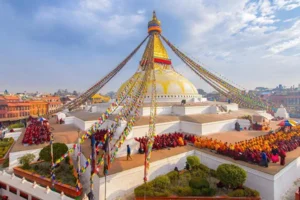
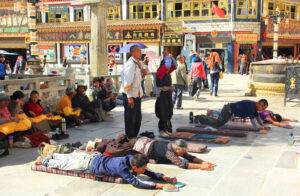
In Nepal, some of the most powerful scenes during Saka Dawa can be witnessed around Swayambhunath and Boudhanath, where devotees circumambulate the sacred stupas while reciting mantras, spinning prayer wheels, offering butter lamps, and performing full-body prostrations. Elderly devotees, monks, nuns, and lay practitioners alike can often be seen bowing repeatedly upon the stone pathways surrounding these ancient sacred monuments, sometimes from sunrise until late into the night. During Saka Dawa, these sacred spaces become not only centers of religious ritual, but living expressions of Himalayan Buddhist philosophy, devotion, and cultural continuity.
To an outside observer, such practices may appear physically exhausting or difficult to understand. Why would someone repeatedly lower their body to the ground thousands of times? Why would devotees voluntarily engage in fasting, silence, and physical hardship during Nyungne retreats? In an age dominated by speed, convenience, and material comfort, these ancient practices may seem disconnected from modern life. Yet for practitioners, they represent profound methods of transforming the mind and cultivating compassion.

The tradition of prostration has deep historical roots within Buddhism itself. Acts of bowing and reverence existed in ancient Indian spiritual traditions long before Buddhism emerged. After the enlightenment of Gautama Buddha over 2,500 years ago, prostration became integrated into Buddhist practice as a symbolic expression of humility, respect, gratitude, and surrender of the ego. In early Buddhist communities, disciples prostrated before the Buddha not as worship of a god, but as recognition of awakened wisdom and compassion.
As Buddhism spread into Tibet and the Himalayan regions from ancient India between the seventh and eleventh centuries, prostration evolved into a highly developed spiritual discipline within Vajrayana and Mahayana traditions. Tibetan Buddhist practitioners began incorporating full-body prostrations into pilgrimage journeys, preliminary practices known as Ngöndro, and large-scale devotional acts performed over months or even years. The practice became especially associated with purification of negative karma, cultivation of humility, and preparation of the mind for deeper meditation and spiritual understanding.
In Himalayan Buddhist philosophy, prostration is far more than ritual movement. It represents a symbolic dismantling of pride, attachment, anger, greed, and self-centeredness. The human ego naturally seeks elevation, recognition, and control. Prostration reverses this impulse. When practitioners lower their entire body to the earth, they acknowledge human impermanence and interdependence. The body itself becomes an instrument of meditation.

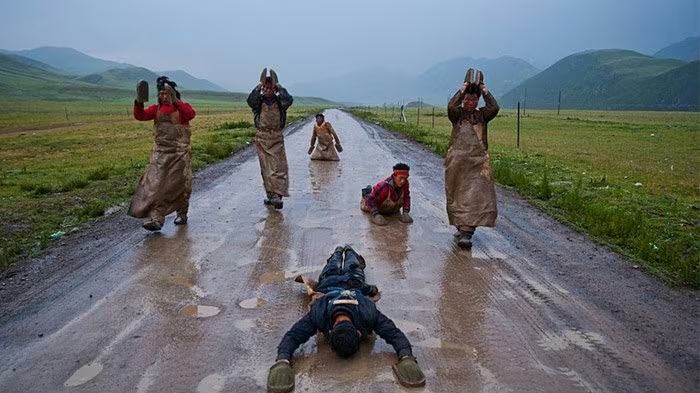
This is why many pilgrims perform prostrations while traveling toward sacred destinations. Across Tibet, Nepal, Bhutan, and India, devotees have historically undertaken extraordinary pilgrimage journeys through mountains, valleys, and difficult terrain while repeatedly prostrating along the route. Some pilgrims spend years making their way toward sacred places such as Bodh Gaya, Mount Kailash, Lhasa, or major Himalayan monasteries. These journeys are not intended as displays of suffering, but as methods of spiritual discipline and inner transformation.
Similarly, the practice of Nyungne fasting carries deep historical and spiritual significance. The origins of Nyungne trace back to eleventh-century India and to the legendary female Buddhist master Gelongma Palmo, also known as Bhikshuni Lakshmi. According to Buddhist tradition, Gelongma Palmo was born as an Indian princess who renounced royal life in order to become a devoted Buddhist nun. After later contracting leprosy, she was reportedly cast out of society and forced to live in isolation.
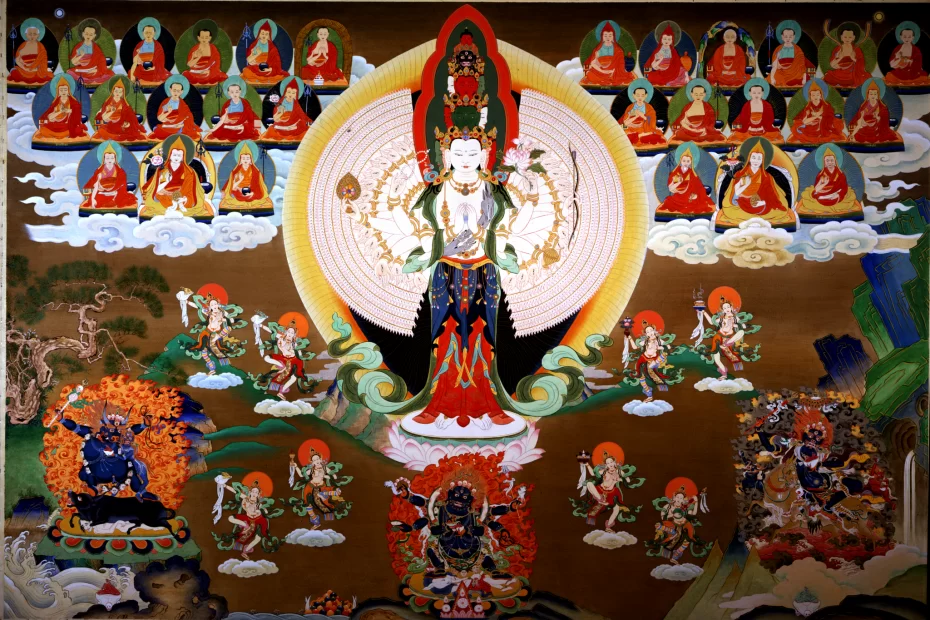
In the midst of profound physical suffering and social rejection, Gelongma Palmo devoted herself entirely to the intensive practice of the 1000-Armed Avalokiteshvara, known in Tibetan Buddhism as Chenrezig. Through rigorous fasting, continuous mantra recitation, meditation, and visualization practice, she is believed to have completely purified her illness and attained deep spiritual realization. According to the traditional lineage history, the Nyungne practice itself was directly transmitted from Avalokiteshvara to Gelongma Palmo through visionary experience.
From Gelongma Palmo, the Nyungne lineage passed to Indian yogis and scholars such as Pandit Chandra Kumara before eventually entering Tibet and Nepal during the twelfth century. Over time, great Tibetan masters, including Gyalsey Thogmey, widely disseminated the practice throughout the Himalayan region. Nyungne eventually became integrated into all four major schools of Tibetan Buddhism, Nyingma, Kagyu, Sakya, and Gelug, and remains one of the most respected purification practices within Himalayan Buddhist traditions today.

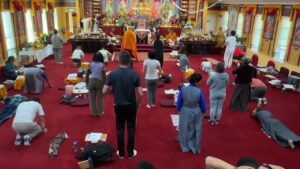
Nyungne generally involves a strict two-day retreat cycle combining fasting, silence, prayer, mantra recitation, meditation, ethical discipline, and devotional practice. On the first day, practitioners usually consume one simple vegetarian meal before noon. On the second day, participants traditionally refrain from all food and water while maintaining silence and continuous spiritual practice. Many practitioners repeat multiple Nyungne cycles consecutively during Saka Dawa, sometimes for weeks.
Yet the purpose of Nyungne is not punishment or self-denial for its own sake. Buddhism itself rejects extreme self-mortification. Rather, Nyungne seeks to interrupt habitual attachment, craving, distraction, and sensory dependence. Human beings continuously seek comfort, stimulation, and satisfaction through consumption. Fasting temporarily weakens these patterns and allows practitioners to directly observe the restless nature of desire itself.
At a deeper level, Nyungne also cultivates empathy. Hunger becomes a reminder of the suffering experienced daily by countless beings living in poverty, displacement, illness, and hardship. In this way, fasting transforms from a purely personal practice into an exercise in compassion and interconnectedness.
The sacred month of Saka Dawa intensifies the significance of these practices because it commemorates the birth, enlightenment, and parinirvana of the Buddha. In Himalayan Buddhist traditions, actions performed during this month are believed to generate greatly multiplied karmic effects. As a result, devotees increase acts of generosity, vegetarianism, ethical conduct, prayer, pilgrimage, and spiritual discipline.

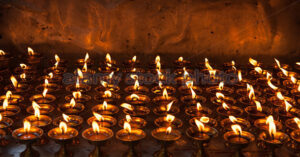
At sacred sites such as Swayambhunath and Boudhanath in Kathmandu, Nepal, the atmosphere during Saka Dawa reflects this collective aspiration. Thousands of butter lamps illuminate the night. Prayer flags move with the wind above ancient stupas. Monks chant scriptures while elderly pilgrims slowly circle the shrines with prayer beads in hand. Young practitioners join older generations in prostrations and fasting retreats. In these moments, the sacred geography of Kathmandu becomes intertwined with centuries of Himalayan Buddhist memory and devotion.
Critics sometimes dismiss these practices as outdated rituals lacking practical value in modern society. Yet such criticism often fails to recognize their deeper psychological and philosophical dimensions. Modern civilization increasingly encourages distraction, materialism, competition, speed, and individualism. Anxiety, loneliness, and emotional exhaustion have become widespread realities. In such an environment, practices centered upon humility, silence, compassion, discipline, and self-awareness may hold greater relevance than ever before.
At the same time, these traditions also preserve cultural continuity for Himalayan communities facing rapid modernization and globalization. In immigrant communities especially, practices such as Nyungne and pilgrimage prostration help younger generations remain connected to ancestral values, language, spiritual philosophy, and collective identity.
However, these traditions also face modern challenges. Commercialization, social media culture, and superficial spiritual tourism sometimes risk turning sacred practices into external performance rather than genuine inner transformation. Buddhism repeatedly emphasizes that intention matters more than appearance. Without compassion, humility, and sincerity, ritual itself can become hollow.
Ultimately, the enduring power of prostration and Nyungne lies in what they reveal about the human condition itself. These practices remind practitioners that inner transformation requires discipline, patience, awareness, and compassion. They challenge the modern assumption that happiness can be found solely through comfort, consumption, and external achievement.
In a world increasingly dominated by noise, speed, and distraction, the sight of devotees quietly performing prostrations around Boudhanath or entering silent fasting retreats during Saka Dawa offers a different vision of human life, one rooted not in conquest or accumulation, but in humility, compassion, awareness, and awakening.